
Class 1, Division 1 Explosion Proof Air Conditioners
Class 1, Division 1 is the most stringent hazardous location classification for flammable gas and vapor environments. If your facility requires Class 1, Division 1 cooling equipment, you need units that can operate continuously in an atmosphere where flammable gases or vapors are regularly present — not just under fault conditions, but as a normal part of daily operations.
We fabricate and modify air conditioning units to meet Class 1, Division 1 specifications for all applicable groups.
What Is a Class 1, Division 1 Location?
Under the National Electrical Code (NEC Article 500), a Class 1 location is any area where flammable gases or vapors may be present in quantities sufficient to produce an explosive or ignitable mixture with air.
Division 1 means the hazardous condition exists under normal operating conditions. This includes:
- Locations where ignitable concentrations of gases or vapors exist continuously or intermittently under normal operations
- Locations where a breakdown or faulty operation of process equipment might release ignitable concentrations — and might also cause simultaneous failure of electrical equipment
- Locations adjacent to Class 1, Division 1 areas where ignitable concentrations might occasionally be communicated
Common Class 1, Division 1 Environments
- Spray painting booths and operations where flammable solvents are used continuously
- Areas adjacent to open tanks or vats containing volatile flammable liquids
- Portions of petroleum refining facilities where gases or vapors are routinely vented or released
- Solvent recovery rooms
- Dip tanks using flammable liquids
- Inadequately ventilated pump rooms handling flammable liquids or gases
- Interiors of refrigerators and freezers used to store volatile flammable materials
Class 1 Groups: A, B, C, and D
Class 1 locations are further divided into groups based on the specific flammable material present. The group determines which explosion-proof components are required. Each group has a different maximum experimental safe gap (MESG) and minimum igniting current (MIC) — properties that govern how explosion-proof enclosures must be designed to contain any internal ignition.
Group A — Acetylene
Group A covers acetylene, which has the lowest minimum ignition energy of any common industrial gas — approximately 0.017 mJ, compared to 0.25 mJ for hydrogen and 0.24 mJ for methane. It also forms explosive compounds with copper, silver, and mercury on contact.
We do not offer explosion-proof air conditioning for Group A environments. The equipment requirements are so stringent that practical HVAC solutions are essentially unavailable. If your facility handles acetylene, consult your safety engineer about isolation, ventilation, and administrative controls as primary risk mitigation strategies.
Group B — Hydrogen and Highly Hazardous Gases
Group B covers gases with very low ignition energy — materials that can ignite from very small sparks. Equipment rated for Group B also satisfies Groups C and D requirements.
Common substances: Hydrogen, butadiene, ethylene oxide, propylene oxide, acrolein
Common industries: Hydrogen generation, chemical processing, semiconductor manufacturing, certain pharmaceutical processes
Group C — Ethylene and Ether Vapors
Group C is the second tier of Class 1 hazard intensity. Equipment designed for Group C will also satisfy Group D requirements, but not Group B or A.
Common substances: Ethyl ether (diethyl ether), ethylene, cyclopropane, ethylene dichloride, trimethylamine
Common industries: Chemical plants, pharmaceutical manufacturing, laboratories, plastics and rubber production, some petroleum refining operations
Group D — Petroleum Vapors and Natural Gas
Group D is the most common classification encountered in oil and gas, refining, and general petrochemical work. Most NFPA 497 classified facilities in the petroleum industry fall into Group D for their primary hazard.
Common substances: Gasoline, hexane, naphtha, benzene, butane, propane, natural gas, alcohol, acetone, benzol, ammonia, lacquer solvent vapors
Common industries: Oil refineries, gas processing plants, pipeline stations, chemical storage, fueling facilities, LPG handling
What Makes Equipment Class 1, Division 1 Compliant?
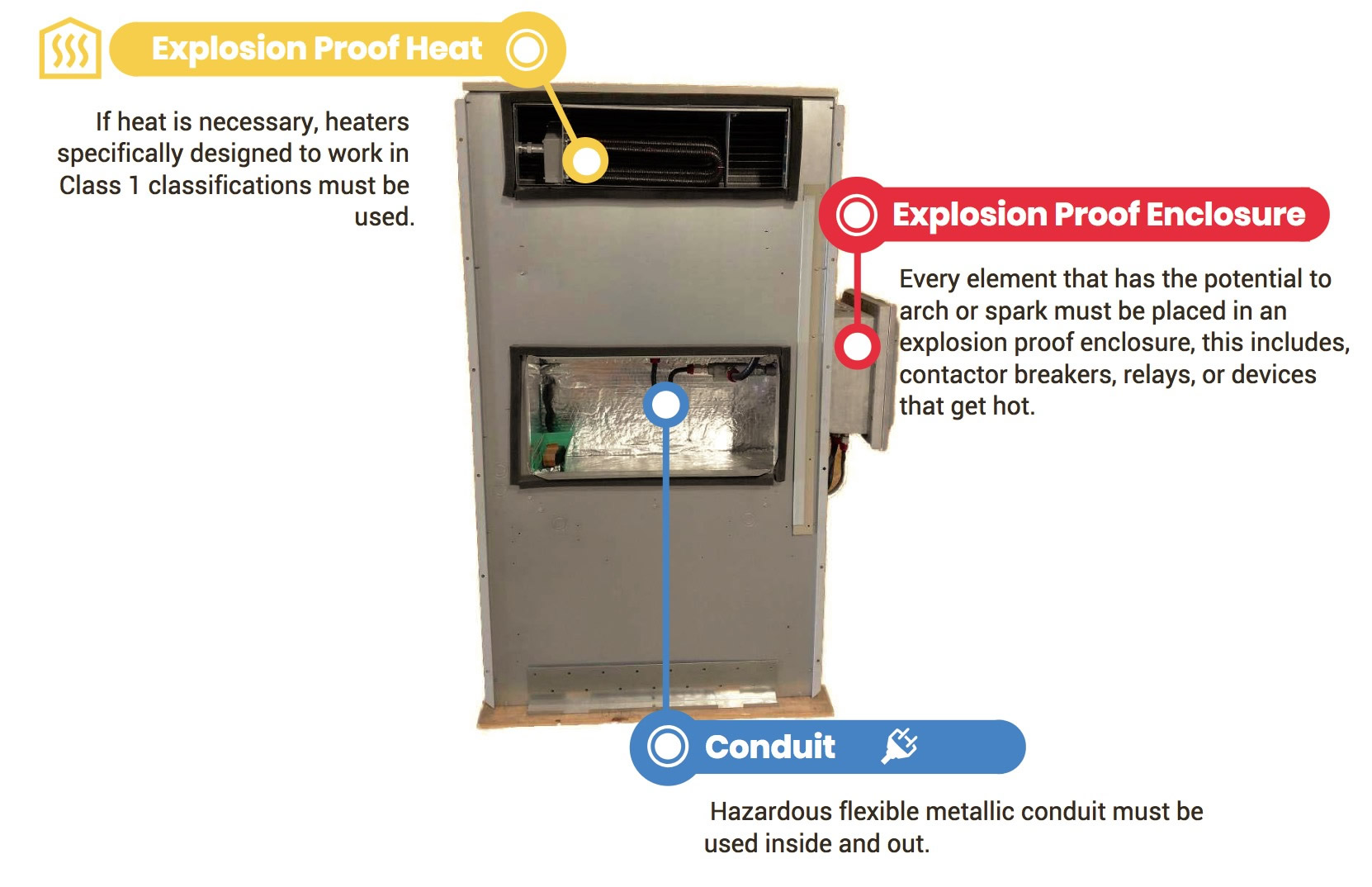
Air conditioning equipment operating in a Class 1, Division 1 area must be designed so that any electrical arcing, sparking, or heat generation cannot ignite the surrounding atmosphere. For an air conditioner, that means:
Explosion-proof motors — All motors (compressor, condenser fan, evaporator fan) must be UL-listed explosion-proof motors rated for the specific group. An explosion-proof motor is built with tight machining tolerances and robust enclosures that contain any internal ignition without allowing flame or hot gases to escape.
Sealed conduit and fittings — All wiring must run in rigid metallic conduit with explosion-proof fittings. Each conduit entry into an enclosure must be sealed with compound to prevent the migration of gases.
Explosion-proof enclosures — Electrical controls, junction boxes, and any component that may arc must be housed in explosion-proof enclosures rated for the applicable group.
No surface ignition — Equipment surfaces must not exceed the auto-ignition temperature of the gases present (addressed through temperature class/T-code ratings, covered separately).
Division 1 requirements are more extensive than Division 2 because the hazard is assumed to be present during normal operation — there is no allowance for “non-incendive” components or general-purpose enclosures, as there may be in Division 2.
Class 1, Division 1 Air Conditioner Modifications
We take standard air conditioning units — typically Bard wall-mount units, though we can work with any brand — and re-engineer them for Class 1, Division 1 service:
- Motor replacement: All motors are replaced with Division 1, group-appropriate explosion-proof motors
- Conduit and sealing: Complete re-wiring with rigid conduit and code-compliant seals at all entries
- Enclosure work: Control boxes and junction boxes replaced or upgraded to explosion-proof equivalents
- Coil coating: Where the environment warrants, coils are treated with protective coating for corrosive or coastal conditions
- Documentation: Full documentation package for compliance records
Division 1 modifications are more involved — and more expensive — than Division 2. We’ll give you a firm number on your first call.
Pricing and Quotes
Class 1, Division 1 modifications are quoted on a project-by-project basis. The scope of work depends on the specific group, unit size, and whether both indoor and outdoor sections require modification.
Call (844) 925-5668 for a quote. We typically respond within 24–48 hours.
Related Pages
- What Is an Explosion Proof Air Conditioner? — complete guide with classifications, pricing, and real installations
- Class 1, Division 2 — if hazardous gases are only present under abnormal conditions (less costly)
- Class 2, Division 1 — for combustible dust environments
- NEC Article 500 vs. 505 — Class/Division vs. Zone classification
- Explosion Proof Mini Splits — the most affordable option
- Explosion Proof Bard Air Conditioners — wall-mount units
- How Much Does It Cost? — pricing breakdown
- How to Choose — buyer’s guide
- FAQ
- Get a Quote