
Explosion Proof Mini Split Air Conditioners
Mini splits have become the most affordable way to put explosion-proof cooling into a hazardous location. They have effectively replaced window units as the budget-friendly entry point for classified spaces — delivering reliable cooling at a price point that makes compliant HVAC accessible for small enclosures, shelters, and control rooms.
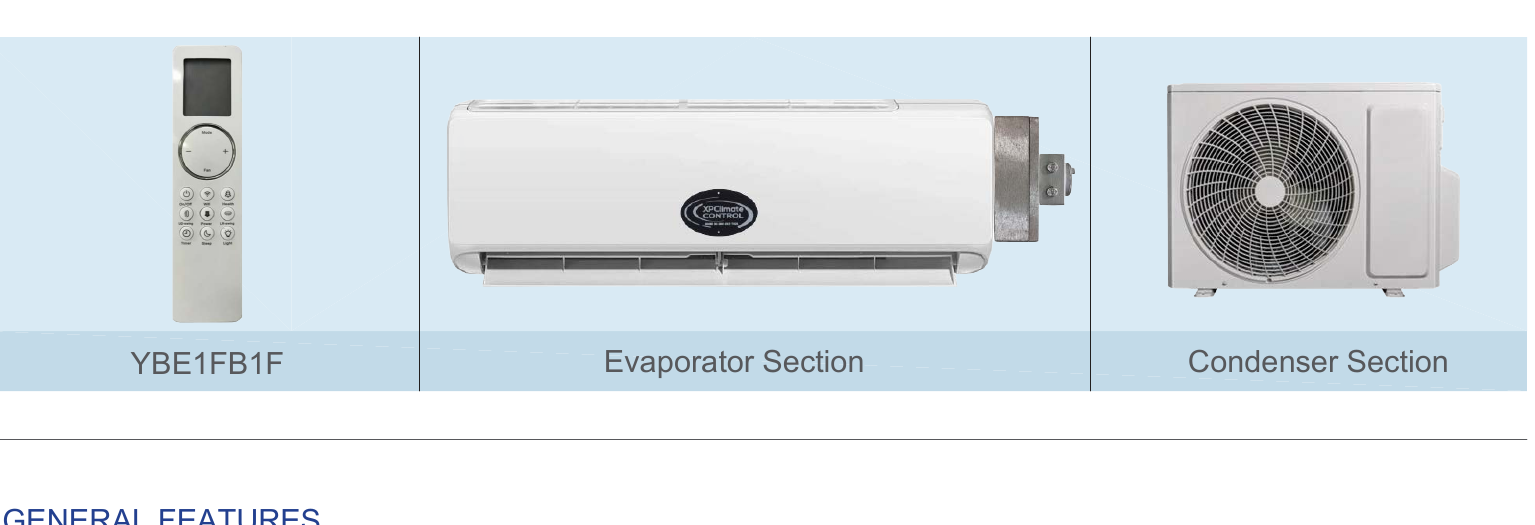
A mini split is exactly what the name implies: the system is split into two sections. A compact indoor evaporator head mounts on a wall or ceiling inside the classified space. An outdoor condenser unit mounts on an exterior wall, rooftop, or ground pad outside. The two sections are connected by refrigerant lines that run through a small penetration in the wall.
We modify mini splits from major manufacturers to meet your exact hazardous location classification — Class 1 or Class 2, Division 1 or Division 2, any group. Each section is independently rated to match the classification on its side of the wall.
Why Mini Splits Are the New Affordable Option
Window units were historically the least expensive path to explosion-proof cooling. Due to recent refrigerant standard changes, explosion-proof window units are currently unavailable industry-wide — the components needed to modify them to hazardous location standards cannot be sourced under the new refrigerant regulations.
Mini splits have stepped into that role and, in many ways, are a better product for the application:
Affordability. Mini split modifications start at price points comparable to where window units were, making them the most cost-effective explosion-proof cooling option available today.
Higher efficiency. Modern mini splits use inverter-driven compressors that are significantly more energy-efficient than the fixed-speed compressors in traditional window units. Lower operating costs over the life of the equipment.
Quieter operation. The compressor is in the outdoor unit, so the indoor head runs quietly — an advantage in control rooms where operators spend extended shifts.
Flexible capacity range. Mini splits are available from small fractional-ton units up to multi-ton capacities, covering the same range window units served and beyond.
Easier installation in retrofit situations. The indoor head mounts on any wall or ceiling surface. The refrigerant line penetration through the wall is small — typically a 3-inch hole rather than the large rectangular opening a window unit or wall-mount requires. This makes mini splits practical for structures where cutting a large wall opening is difficult or undesirable.
The Trade-Off: Indoor Space
The one thing a mini split requires that a Bard wall-mount does not is interior space. The indoor evaporator head — typically a slim rectangular unit — mounts on a wall or hangs from the ceiling inside the classified space. It is compact and usually installs high up near the ceiling where it is out of the way, but it does take up some interior real estate.
For most applications, this is not a problem. Control rooms, instrument shelters, and equipment enclosures typically have available wall or ceiling space for the indoor head.
If interior space is truly at a premium — for example, a tightly packed MCC building where every wall is occupied by equipment — a Bard wall-mount unit is the better choice. Bard wall-mounts are completely self-contained on the exterior of the building. You only need to cut a supply and return air opening through the wall for air circulation. Nothing protrudes into the interior space.
What We Modify
The explosion-proof modification process for a mini split covers both sections:
Indoor head (evaporator) — The fan motor is replaced with an explosion-proof rated motor certified for your Class, Division, and Group. All electrical connections, control boards, and wiring are enclosed in explosion-proof rated housings with sealed penetrations. Rigid metallic conduit replaces any standard wiring.
Outdoor unit (condenser) — Compressor, condenser fan motor, and all electrical components are replaced or enclosed with explosion-proof rated hardware. When the outdoor unit sits in a non-classified area, this section may not require full explosion-proof modification — reducing cost.
Refrigerant lines and wall penetration — All connections through the classified boundary are sealed per NEC requirements. Sealing fittings prevent flame propagation through the line penetration.
Controls — Thermostat, disconnect, and control wiring are rated for the classified environment. Standard wireless or IR remotes are replaced with hardwired, rated controls.
Documentation — Full documentation package for maintenance records and compliance files.
Classification Options
We modify mini splits for any hazardous location classification:
- Class 1, Division 2, Groups C & D — the most common configuration for refineries, petrochemical facilities, and chemical plants
- Class 1, Division 1, Groups C & D — for areas where flammable gases are present continuously or under normal operating conditions
- Class 2, Division 1 or 2, Groups E, F, G — for combustible dust environments including grain handling, pharmaceutical manufacturing, and mining
- Mixed classifications — indoor and outdoor units rated independently to match the actual conditions on each side
Technical Specifications
Our explosion-proof mini splits are built on a foundation of premium R32 refrigerant DC inverter technology. Performance specifications below are for the 24,000 BTU/h heat pump model — other capacities (9,000 / 12,000 / 18,000 / 30,000 / 36,000 BTU/h) follow the same engineering platform with proportional sizing.
System Performance — 24,000 BTU/h example
| Specification | Value |
|---|---|
| Cooling capacity (rated @ 95°F) | 24,000 BTU/h |
| Cooling capacity (variable inverter range) | 5,800 – 26,270 BTU/h |
| Heating capacity (rated @ 47°F) | 24,000 BTU/h |
| Heating capacity (variable inverter range) | 5,400 – 26,600 BTU/h |
| Heating capacity @ 17°F | 19,200 BTU/h |
| Heating capacity @ 5°F | 15,700 BTU/h |
| SEER2 | 19.0 |
| EER2 | 11.9 |
| HSPF2 | 8.5 |
| COP @ 5°F | 1.75 |
| Cooling temperature range | 0°F to 118°F |
| Heating temperature range | −13°F to 75°F |
| Refrigerant | R32 (next-gen low-GWP) |
Indoor Unit
| Specification | Value |
|---|---|
| Air flow (min – max) | 412 – 677 CFM |
| Sound pressure level (min – max) | 36 – 51 dB(A) |
| Dehumidification | 5.28 pt/hr |
| Indoor fan type | Crossflow, 6 speeds |
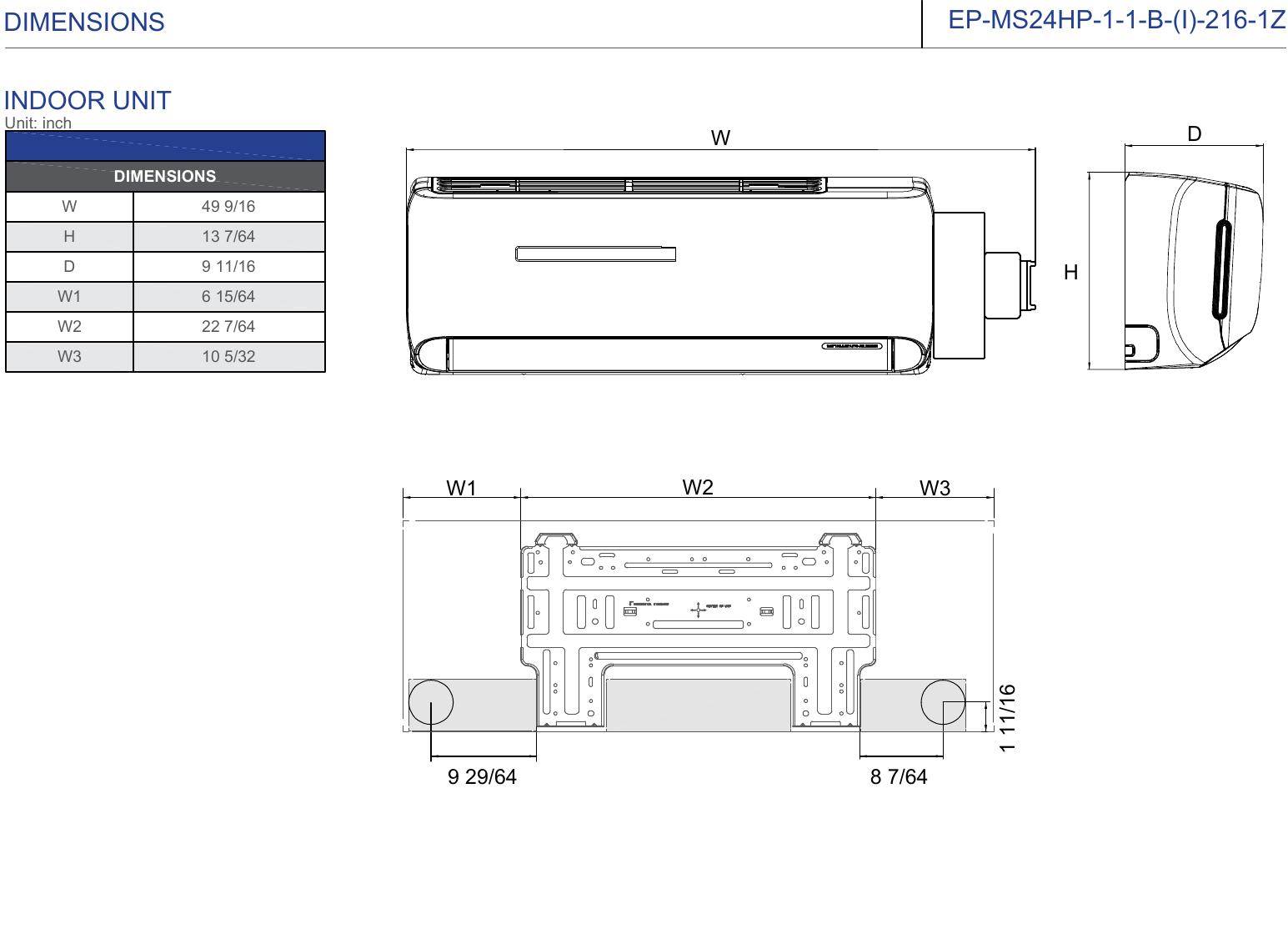
| External dimensions (W × H × D) | 49-9/16” × 13-7/64” × 9-11/16” |
| Net weight | 45.1 lbs |
| Mounting | Wall-mounted (cassette available on request) |
Outdoor Unit
| Specification | Value |
|---|---|
| Compressor | GREE G20 single-cylinder, 1-stage inverter |
| Sound pressure level | 58 dB(A) |
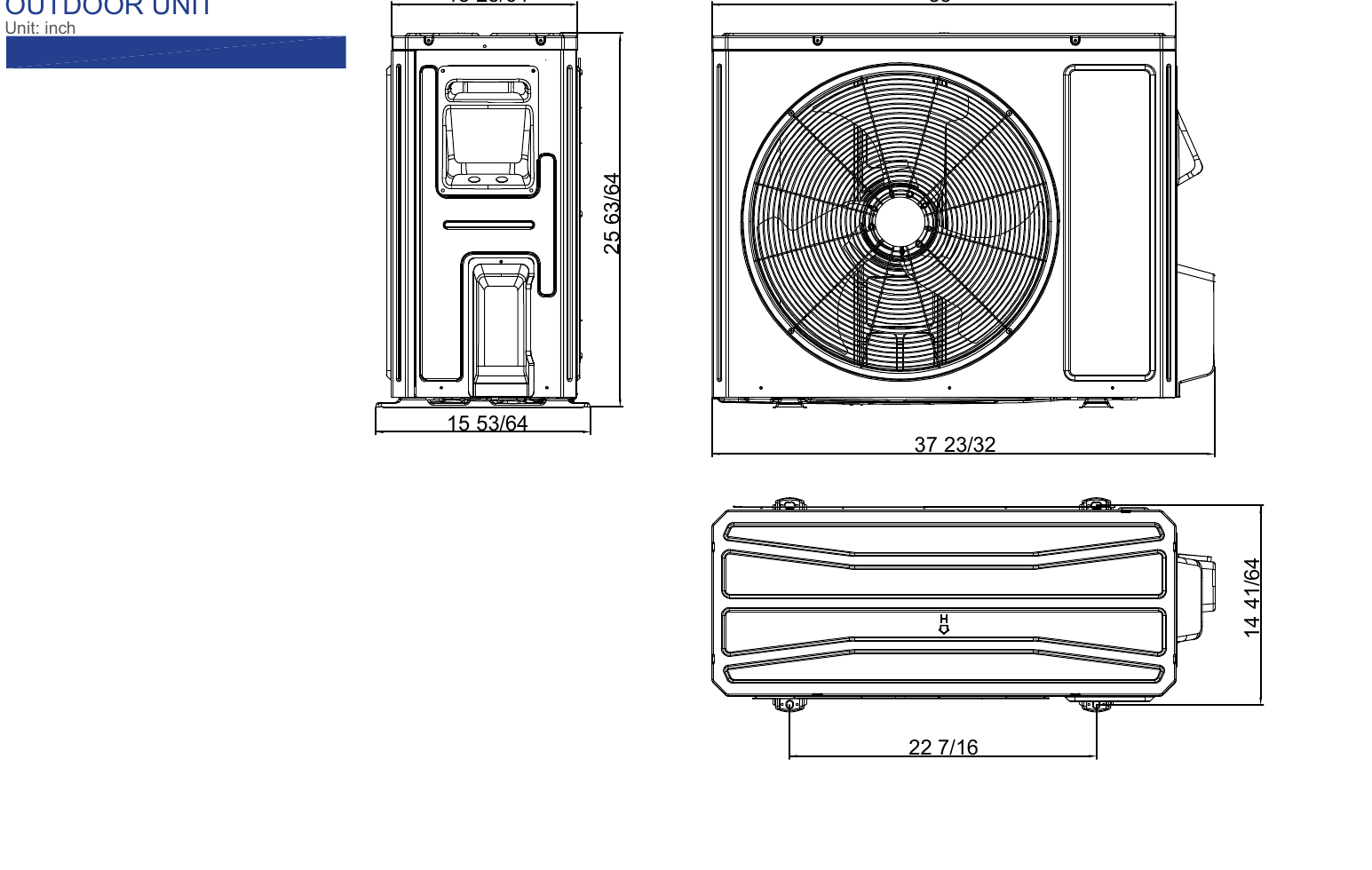
| External dimensions (W × H × D) | 37-23/32” × 25-63/64” × 15-53/64” |
| Net weight | 93.7 lbs |
| Outdoor fin coating | Acrylic-resin / anti-corrosive (blue, 500 hrs salt spray tested) |
| Operating range | −13°F to 118°F (with intelligent preheating + basepan heater) |
Refrigerant Piping
| Specification | Value |
|---|---|
| Line set size (liquid – gas, flared) | 1/4” – 1/2” |
| Refrigerant charge (R32) | 42.3 oz |
| Additional charge | 0.1 oz/ft |
| Pre-charge length | 25 ft |
| Pipe length (min – max) | 10 – 131 ft |
| Maximum pipe elevation | 82 ft |
Electrical
| Specification | Value |
|---|---|
| Power supply | 208 – 230V / 1 PH / 60 Hz |
| Voltage range (min – max) | 187 – 253V |
| Rated current (cooling) | 11 A |
| Rated current (heating) | 12 A |
| MOCP | 20 A |
| MCA | 15 A |
| Main power wire size | Per local code |
| Interconnecting wire size | 14/4 AWG |
| Indoor unit power | Powered by the outdoor unit |
Features & Function Summary
Compressor / system technology:
- Inverter Type G20
- Ultra Low Frequency Torque Control
- Power Factor Correction
- Basepan with electric heater
- Compressor with electric heater
- Intelligent defrosting + force defrosting
- Intelligent preheating
- Low voltage startup
- Memory / power failure recovery
- Self diagnosis
- WiFi included
- A2L leak detection sensor (factory installed for R32 safety)
Wireless remote controller (YBE1FB1F) functions:
- Auto mode + auto fan
- Manual horizontal swing + auto vertical swing
- Clock on remote
- Dry mode + Dry Anti-Mildew (X-Fan) mode
- Energy saving mode + sleep mode + turbo mode
- Quiet mode + I Feel function (uses remote temp sensor)
- Room temperature display
- Timer mode
- Freeze guard mode (46°F)
- Display on/off control
- Remote controller lock
Installation Requirements
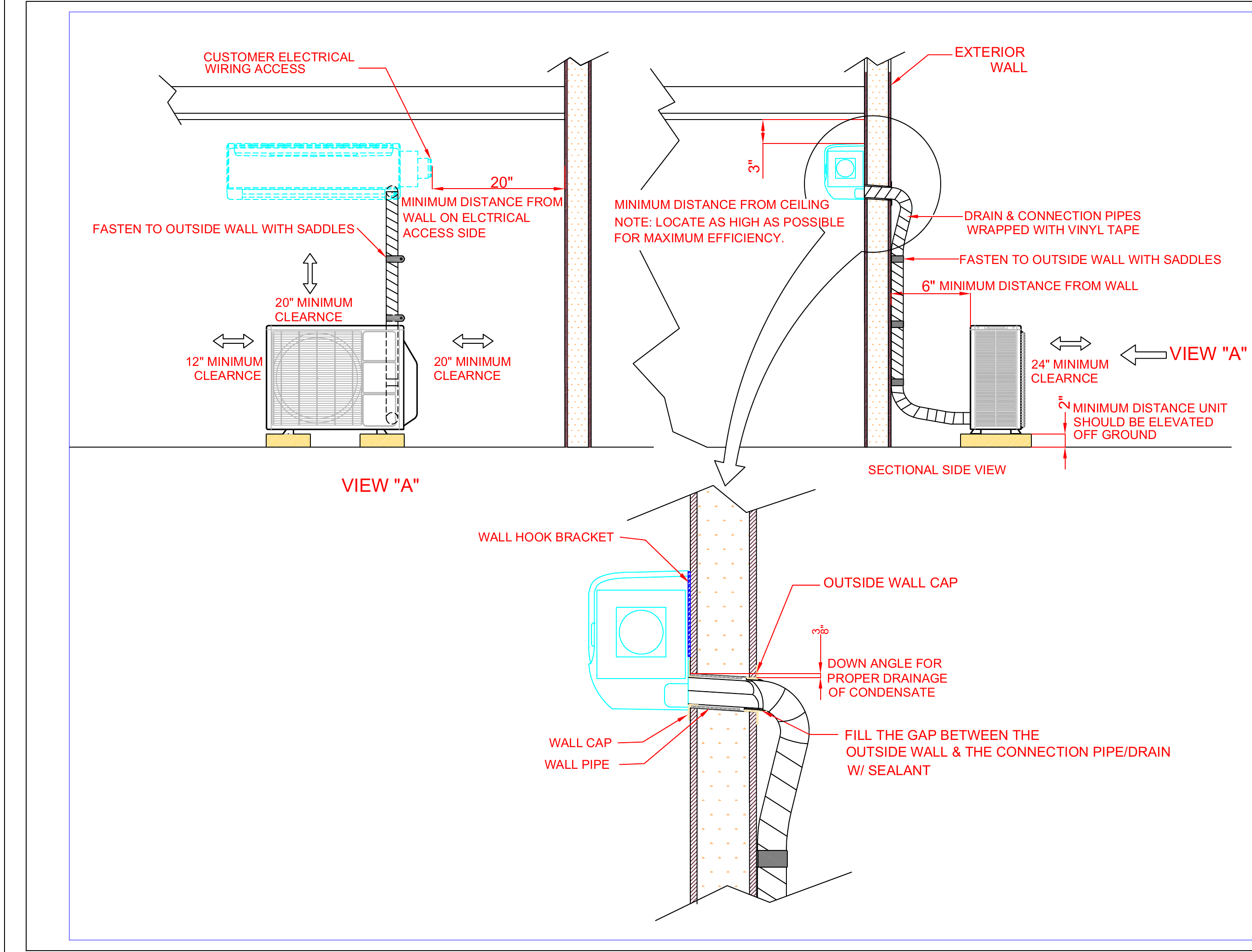
Proper clearances and installation are critical for both performance and serviceability. The diagram below is the XP Climate Control general arrangement (GA) drawing for ductless mini split installation:
Minimum clearances:
| Location | Clearance |
|---|---|
| Indoor unit, above (ceiling) | 6” minimum |
| Indoor unit, sides (walls) | 12” minimum |
| Outdoor unit, sides | 20” minimum |
| Outdoor unit, back / electrical access side | 20” minimum from wall |
| Outdoor unit, front (service access) | 24” minimum |
| Outdoor unit, below (ground) | 2” minimum elevation |
Installation notes:
- Locate the indoor evaporator as high as possible on the wall for maximum efficiency
- Wall pipe must be installed with a slight down-angle for proper condensate drainage
- Fill the gap between the outside wall and the connection pipe/drain with sealant
- Drain and connection pipes should be wrapped with vinyl tape
- Fasten outdoor unit to outside wall with saddles where applicable
- Outside wall cap required at pipe penetration point
Pricing
We publish our pricing because most competitors won’t. Below are current list prices on our explosion proof mini split heat pumps — R-32 refrigerant, single zone, 208–230V / 1ph / 60Hz — across all four common classification tiers.
Configurations. Each unit is available in three modification scopes:
- Interior only — the indoor evaporator head is rated; the outdoor condenser sits in a non-classified area (lowest cost)
- Exterior only — the outdoor condenser is rated; the indoor head is in a non-classified area
- Interior + Exterior — both sections are rated for the classified zone (highest cost)
Reading the model number: EP-MS[BTU]HP-[Class]-[Div]-[Group]-([Scope])-216-1Z
[BTU] = capacity in thousands · [Class]-[Div] = 1-2 (Div 2) or 1-1 (Div 1) · [Group] = X (Groups C, D) or B (Groups B, C, D) · [Scope] = I / E / IE · 216 = 208–230V/1ph/60Hz · 1Z = wall-mount (cassette = 1CAS)
Class 1, Division 2 — Groups C & D
The most common classification at oil refineries, petrochemical plants, and natural gas facilities.
| Model Number | Capacity | Configuration | List Price |
|---|---|---|---|
EP-MS9HP-1-2-X-(I)-216-1Z | 9,000 BTU | Interior only | $11,988 |
EP-MS9HP-1-2-X-(E)-216-1Z | 9,000 BTU | Exterior only | $15,335 |
EP-MS9HP-1-2-X-(IE)-216-1Z | 9,000 BTU | Interior + Exterior | $16,982 |
EP-MS12HP-1-2-X-(I)-216-1Z | 12,000 BTU | Interior only | $12,598 |
EP-MS12HP-1-2-X-(E)-216-1Z | 12,000 BTU | Exterior only | $15,945 |
EP-MS12HP-1-2-X-(IE)-216-1Z | 12,000 BTU | Interior + Exterior | $17,592 |
EP-MS18HP-1-2-X-(I)-216-1Z | 18,000 BTU | Interior only | $15,518 |
EP-MS18HP-1-2-X-(E)-216-1Z | 18,000 BTU | Exterior only | $18,865 |
EP-MS18HP-1-2-X-(IE)-216-1Z | 18,000 BTU | Interior + Exterior | $20,512 |
EP-MS24HP-1-2-X-(I)-216-1Z | 24,000 BTU | Interior only | $16,767 |
EP-MS24HP-1-2-X-(E)-216-1Z | 24,000 BTU | Exterior only | $20,114 |
EP-MS24HP-1-2-X-(IE)-216-1Z | 24,000 BTU | Interior + Exterior | $21,761 |
EP-MS30HP-1-2-X-(I)-216-1Z | 30,000 BTU | Interior only | $17,109 |
EP-MS30HP-1-2-X-(E)-216-1Z | 30,000 BTU | Exterior only | $20,456 |
EP-MS30HP-1-2-X-(IE)-216-1Z | 30,000 BTU | Interior + Exterior | $22,103 |
EP-MS36HP-1-2-X-(I)-216-1Z | 36,000 BTU | Interior only | $17,984 |
EP-MS36HP-1-2-X-(E)-216-1Z | 36,000 BTU | Exterior only | $21,331 |
EP-MS36HP-1-2-X-(IE)-216-1Z | 36,000 BTU | Interior + Exterior | $22,978 |
Class 1, Division 2 — Groups B, C & D
Adds hydrogen and other Group B materials to Groups C & D coverage.
| Model Number | Capacity | Configuration | List Price |
|---|---|---|---|
EP-MS9HP-1-2-B-(I)-216-1Z | 9,000 BTU | Interior only | $12,258 |
EP-MS9HP-1-2-B-(E)-216-1Z | 9,000 BTU | Exterior only | $15,605 |
EP-MS9HP-1-2-B-(IE)-216-1Z | 9,000 BTU | Interior + Exterior | $17,252 |
EP-MS12HP-1-2-B-(I)-216-1Z | 12,000 BTU | Interior only | $12,868 |
EP-MS12HP-1-2-B-(E)-216-1Z | 12,000 BTU | Exterior only | $16,215 |
EP-MS12HP-1-2-B-(IE)-216-1Z | 12,000 BTU | Interior + Exterior | $17,862 |
EP-MS18HP-1-2-B-(I)-216-1Z | 18,000 BTU | Interior only | $15,788 |
EP-MS18HP-1-2-B-(E)-216-1Z | 18,000 BTU | Exterior only | $19,135 |
EP-MS18HP-1-2-B-(IE)-216-1Z | 18,000 BTU | Interior + Exterior | $20,782 |
EP-MS24HP-1-2-B-(I)-216-1Z | 24,000 BTU | Interior only | $17,037 |
EP-MS24HP-1-2-B-(E)-216-1Z | 24,000 BTU | Exterior only | $20,384 |
EP-MS24HP-1-2-B-(IE)-216-1Z | 24,000 BTU | Interior + Exterior | $22,031 |
EP-MS30HP-1-2-B-(I)-216-1Z | 30,000 BTU | Interior only | $17,379 |
EP-MS30HP-1-2-B-(E)-216-1Z | 30,000 BTU | Exterior only | $20,726 |
EP-MS30HP-1-2-B-(IE)-216-1Z | 30,000 BTU | Interior + Exterior | $22,373 |
EP-MS36HP-1-2-B-(I)-216-1Z | 36,000 BTU | Interior only | $18,254 |
EP-MS36HP-1-2-B-(E)-216-1Z | 36,000 BTU | Exterior only | $21,601 |
EP-MS36HP-1-2-B-(IE)-216-1Z | 36,000 BTU | Interior + Exterior | $23,248 |
Class 1, Division 1 — Groups C & D
For areas where flammable gases or vapors are present under normal operating conditions.
| Model Number | Capacity | Configuration | List Price |
|---|---|---|---|
EP-MS9HP-1-1-X-(I)-216-1Z | 9,000 BTU | Interior only | $12,663 |
EP-MS9HP-1-1-X-(E)-216-1Z | 9,000 BTU | Exterior only | $16,010 |
EP-MS9HP-1-1-X-(IE)-216-1Z | 9,000 BTU | Interior + Exterior | $17,657 |
EP-MS12HP-1-1-X-(I)-216-1Z | 12,000 BTU | Interior only | $13,273 |
EP-MS12HP-1-1-X-(E)-216-1Z | 12,000 BTU | Exterior only | $16,620 |
EP-MS12HP-1-1-X-(IE)-216-1Z | 12,000 BTU | Interior + Exterior | $18,267 |
EP-MS18HP-1-1-X-(I)-216-1Z | 18,000 BTU | Interior only | $16,193 |
EP-MS18HP-1-1-X-(E)-216-1Z | 18,000 BTU | Exterior only | $19,540 |
EP-MS18HP-1-1-X-(IE)-216-1Z | 18,000 BTU | Interior + Exterior | $21,187 |
EP-MS24HP-1-1-X-(I)-216-1Z | 24,000 BTU | Interior only | $17,442 |
EP-MS24HP-1-1-X-(E)-216-1Z | 24,000 BTU | Exterior only | $20,789 |
EP-MS24HP-1-1-X-(IE)-216-1Z | 24,000 BTU | Interior + Exterior | $22,436 |
EP-MS30HP-1-1-X-(I)-216-1Z | 30,000 BTU | Interior only | $17,784 |
EP-MS30HP-1-1-X-(E)-216-1Z | 30,000 BTU | Exterior only | $21,131 |
EP-MS30HP-1-1-X-(IE)-216-1Z | 30,000 BTU | Interior + Exterior | $22,778 |
EP-MS36HP-1-1-X-(I)-216-1Z | 36,000 BTU | Interior only | $18,659 |
EP-MS36HP-1-1-X-(E)-216-1Z | 36,000 BTU | Exterior only | $22,006 |
EP-MS36HP-1-1-X-(IE)-216-1Z | 36,000 BTU | Interior + Exterior | $23,653 |
Class 1, Division 1 — Groups B, C & D
Maximum classification coverage including hydrogen-rich Group B environments.
| Model Number | Capacity | Configuration | List Price |
|---|---|---|---|
EP-MS9HP-1-1-B-(I)-216-1Z | 9,000 BTU | Interior only | $12,933 |
EP-MS9HP-1-1-B-(E)-216-1Z | 9,000 BTU | Exterior only | $16,280 |
EP-MS9HP-1-1-B-(IE)-216-1Z | 9,000 BTU | Interior + Exterior | $17,927 |
EP-MS12HP-1-1-B-(I)-216-1Z | 12,000 BTU | Interior only | $13,543 |
EP-MS12HP-1-1-B-(E)-216-1Z | 12,000 BTU | Exterior only | $16,890 |
EP-MS12HP-1-1-B-(IE)-216-1Z | 12,000 BTU | Interior + Exterior | $18,537 |
EP-MS18HP-1-1-B-(I)-216-1Z | 18,000 BTU | Interior only | $16,463 |
EP-MS18HP-1-1-B-(E)-216-1Z | 18,000 BTU | Exterior only | $19,810 |
EP-MS18HP-1-1-B-(IE)-216-1Z | 18,000 BTU | Interior + Exterior | $21,457 |
EP-MS24HP-1-1-B-(I)-216-1Z | 24,000 BTU | Interior only | $17,712 |
EP-MS24HP-1-1-B-(E)-216-1Z | 24,000 BTU | Exterior only | $21,059 |
EP-MS24HP-1-1-B-(IE)-216-1Z | 24,000 BTU | Interior + Exterior | $22,706 |
EP-MS30HP-1-1-B-(I)-216-1Z | 30,000 BTU | Interior only | $18,054 |
EP-MS30HP-1-1-B-(E)-216-1Z | 30,000 BTU | Exterior only | $21,401 |
EP-MS30HP-1-1-B-(IE)-216-1Z | 30,000 BTU | Interior + Exterior | $23,048 |
EP-MS36HP-1-1-B-(I)-216-1Z | 36,000 BTU | Interior only | $18,929 |
EP-MS36HP-1-1-B-(E)-216-1Z | 36,000 BTU | Exterior only | $22,276 |
EP-MS36HP-1-1-B-(IE)-216-1Z | 36,000 BTU | Interior + Exterior | $23,923 |
Cassette-style evaporator (ceiling-recessed, 4-way air discharge) is available as an alternative to the standard wall-mount head — model suffix
1CASinstead of1Z, quoted upon request.
Required Accessories
Every mini split installation requires line set, mounting bracket, and surge protector. These are not optional and not included in the unit pricing above:
| Part Number | Item | Description | Applies to | Price |
|---|---|---|---|---|
LS14381230144C | Line Set | Refrigerant lines | 9,000–12,000 BTU | $496 |
LS14121230144C | Line Set | Refrigerant lines | 18,000–24,000 BTU | $493 |
LS14581230144C | Line Set | Refrigerant lines | 30,000–36,000 BTU | $534 |
REC87733 | Condenser Bracket | Wall-mount bracket, 176 lb capacity | All capacities | $189 |
DTK120240CM | Surge Protector | 120/240 CM+ surge protector | All capacities | $93 |
What’s Included
Every explosion proof mini split heat pump we ship includes:
Indoor section (evaporator):
- High-efficiency DC inverter technology with G20 compressor
- Wall-mounted evaporator section (cassette available on request)
- Copper tube / aluminum fin coils (acrylic-resin anti-corrosive coating)
- Wireless remote with LCD display (YBE1FB1F)
- 6-speed crossflow indoor fan with auto vertical swing
- Composite drain pan
- A2L leak detection sensor (factory installed for R32 safety)
- Self-diagnostics
- Explosion proof motor and overload protection
- WiFi connectivity included
Outdoor section (condenser):
- GREE G20 single-cylinder, 1-stage inverter compressor
- Blue colored fin (500 hours salt spray tested)
- Compressor with electric heater
- Basepan with electric heater (cold weather operation)
- Intelligent defrosting + force defrost
- Intelligent preheating
- Low voltage startup (down to 187V)
- Power factor correction
- Ultra low frequency torque control
- Memory / power failure recovery
- Outdoor operating range: −13°F to 118°F
Documentation and testing:
- Unit fully tested for operational performance and NEC compliance
- Certificate of Conformance to NEC Codes issued
- Owners & maintenance manuals included
- Full classification documentation for your compliance records
Lead Time and Quote Validity
- Standard lead time: 6–8 weeks from order entry. Final availability is confirmed by the factory once the order is placed.
- Quotes valid for: 30 days from the date issued. Material costs can shift, so pricing above is current as of 2026 and subject to periodic adjustment.
- Quote turnaround: Most simple quotes back to you within 24–48 hours. Engineered or custom configurations can take a week or more.
Get a Firm Quote
The prices above are list pricing for standard configurations. Volume orders, custom requirements (Phenicon coating, stainless enclosures, special mounting, redundant systems), and Class 2 dust applications are quoted individually.
Call (844) 925-5668 or submit a quote request — we’ll send firm written pricing within 24–48 hours for standard configurations.
See our full pricing guide for pricing on other unit types and what drives cost overall.
Mini Split vs. Bard Wall-Mount: Which One?
This is the most common question we get from customers who previously would have chosen a window unit. Here is how to decide:
Choose a mini split if:
- You have available wall or ceiling space inside for the indoor head
- You want the most affordable explosion-proof cooling option
- Energy efficiency and quiet operation matter (control rooms with operators)
- The structure makes it difficult to cut a large wall opening (the mini split only needs a small refrigerant line penetration)
- You are in a retrofit situation where the existing wall opening does not fit a self-contained unit
Choose a Bard wall-mount if:
- Interior space is at a premium and you cannot accommodate an indoor unit on the wall or ceiling
- You prefer a completely self-contained system with nothing inside except supply and return air openings
- You need higher capacity (Bard wall-mounts go up to 5 tons)
- The installation environment is extremely demanding (extreme heat, heavy vibration, highly corrosive) — Bard units are built for industrial abuse from the factory
Not sure? Call us at (844) 925-5668 — we can help you figure out the right approach for your specific application in a 10-minute conversation.
Mini Split vs. Full Split System
Mini splits and full split systems both separate the indoor and outdoor components, but they serve different applications:
Mini splits are designed for smaller cooling loads — typically up to 2–3 tons. The indoor head is compact and wall or ceiling mounted. Installation is simpler and cost is lower.
Full split systems are designed for larger cooling loads — 3 tons and up, with no practical upper limit. The indoor unit is a larger air handler that may require floor space or a dedicated mechanical closet. Installation is more complex and cost is higher.
If your cooling load is under 3 tons, a mini split is almost always the better value. Above 3 tons, a full split system becomes necessary.
Corrosion Protection Options
For mini splits installed in corrosive environments — offshore platforms, wastewater treatment plants, coastal facilities, or chemical plants — we offer Phenicon coating, an industrial-grade Sherwin-Williams epoxy novolac applied to the entire unit. Standard coated coils are also available for moderately corrosive environments.
Request a Quote
Tell us your classification, approximate cooling load, and whether the outdoor unit is in a classified area. We will have a quote back to you within 24–48 hours.
Call (844) 925-5668 or request a quote online.
Any Brand Mini Split — Modified to Your Spec
We modify mini splits from any manufacturer — Mitsubishi, Daikin, Fujitsu, LG, Samsung, Carrier, Lennox, and others. As an independent modifier, we’re not locked into a single brand. If your facility has a preferred manufacturer or an existing mini split that needs hazardous location conversion, we can retrofit it to your exact Class, Division, and Group specification.
Related Pages
- What Is an Explosion Proof Air Conditioner? — complete guide with classifications, pricing, and real installations
- Explosion Proof Bard Air Conditioners — wall-mount units, completely self-contained on the exterior
- Explosion Proof Split Systems — for higher capacity requirements
- Explosion Proof Window Air Conditioners — currently unavailable due to refrigerant standards
- How Much Does It Cost? — full pricing breakdown
- How to Choose an Explosion Proof Air Conditioner — step-by-step buyer’s guide
- Class 1, Division 2 Explained — the most common classification
- Pressurization Systems — an alternative for large buildings
- Phenicon Coating — industrial-grade corrosion protection for the entire unit
- Custom Explosion Proof Air Conditioners — specialty builds for non-standard installations
- FAQ — common questions about explosion-proof AC