
Phenicon Coating — The Most Corrosion Resistant Air Conditioner Coating Available
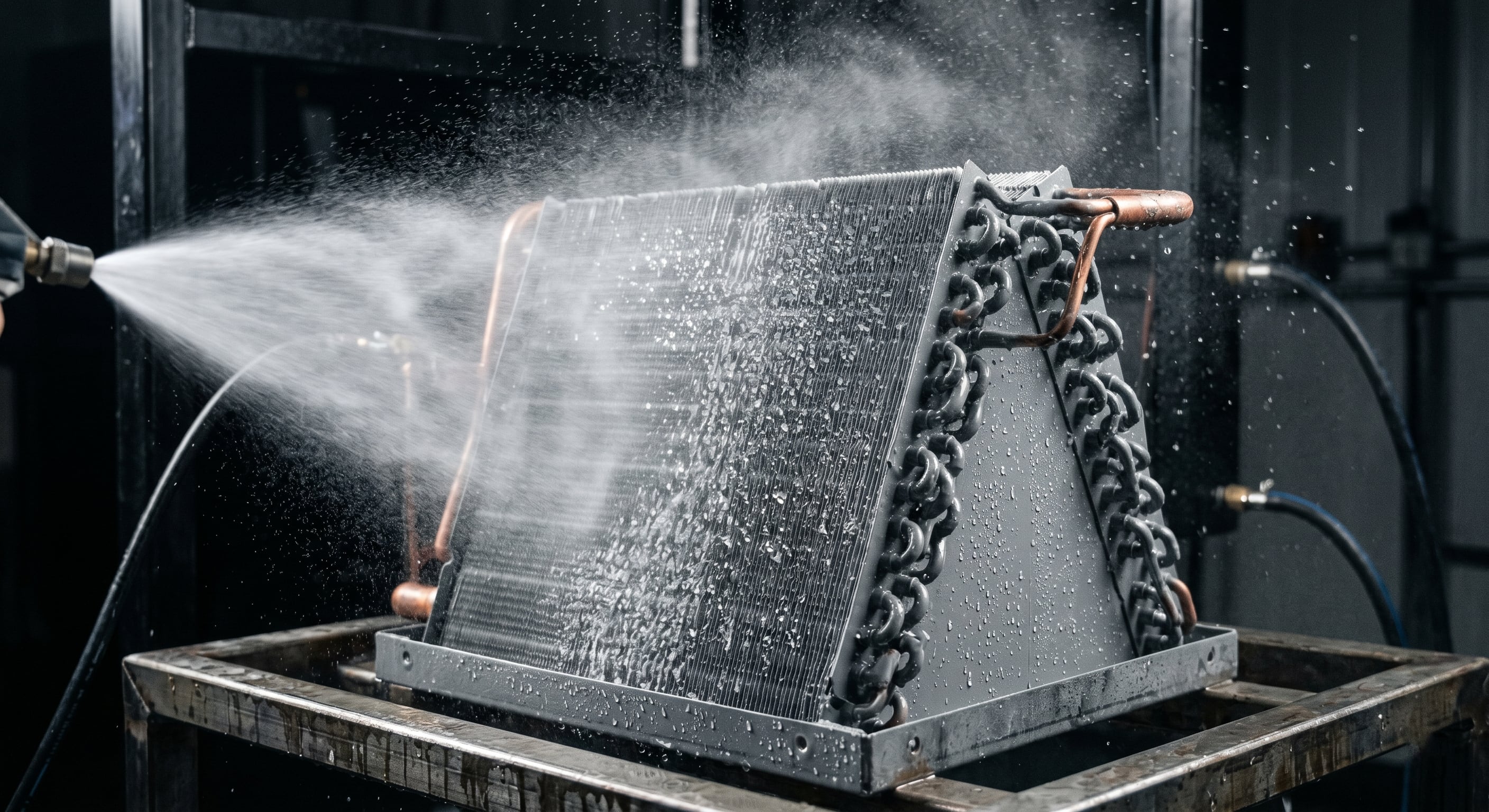
If your air conditioning equipment operates in a corrosive environment and you’re relying on a standard coil coating to protect it, you’re going to replace that unit far sooner than you should. Coatings like Heresite, ElectroFin, and Blygold protect the coil. They don’t touch the cabinet, the copper, the hardware, or the internal components that corrode just as fast in harsh industrial service.
We do something fundamentally different. We coat the entire unit — every surface, inside and out — with Sherwin-Williams Phenicon HS, an epoxy novolac phenolic coating that was engineered to line the inside of crude oil storage tanks and brine vessels. This is not an HVAC product repurposed from a spray can. This is an industrial tank liner applied with the same rigor and surface preparation standards used in petrochemical and marine service.
To our knowledge, no other HVAC shop in the country is using Sherwin-Williams Phenicon in this application. We pioneered this process at XP Climate Control, and the results speak for themselves: units operating for years in the most corrosive environments on earth with zero corrosion failures.
What Is Phenicon HS?
Phenicon HS is a two-part epoxy novolac phenolic coating manufactured by Sherwin-Williams Protective & Marine Coatings. It was formulated as an internal lining for tanks holding crude oil, unleaded gasoline, aromatic solvents, motor fuels, alkalies, and brines.
That last one matters. Brine service — continuous immersion in saltwater — is one of the most aggressive corrosion environments that exists. Phenicon is rated for it. When you apply a coating designed to survive the inside of a brine tank to the outside of an air conditioner, salt spray, hydrogen sulfide, and acid vapors don’t stand a chance.
Key properties:
- Epoxy novolac phenolic chemistry — superior chemical and solvent resistance
- 75% volume solids — heavy, durable film build (10–14+ mils total applied thickness)
- Resistant to crude oil, diesel, jet fuel, aviation gasoline, aromatic solvents, alkalies, and brines at full immersion
- Rated for secondary containment service
- Approved for nuclear power plants and DOE nuclear facilities
- Compliant with NACE SP0198 for corrosion under insulation (CUI)
- Chemical resistance verified against 500+ chemicals in the Sherwin-Williams resistance guide
- Surface burning test: Flame Spread Index 15, Smoke Development Index 35 (ASTM E84)
Why Standard HVAC Coil Coatings Aren’t Enough
Most corrosion resistant coatings for HVAC — Heresite P-413, ElectroFin e-coat, Blygold PoluAl — are designed for the coil only. They’re dip-applied or electrocoated onto the aluminum fins and copper tubes. That’s adequate for a rooftop unit near the coast or a cooling tower in a mildly corrosive plant.
But when your unit sits on an offshore oil platform, processes air inside a wastewater treatment facility, or runs 24/7 at a petrochemical refinery, the coil isn’t the only thing that corrodes. The sheet metal cabinet rusts through. The copper refrigerant lines pit and develop pinhole leaks. The fasteners, brackets, and electrical enclosures all degrade. A coated coil inside a rotting cabinet is a unit that still fails — and you’re buying a replacement years before you should.
Phenicon changes the equation. We coat every component that’s exposed to the corrosive atmosphere:
- Evaporator and condenser coils — both the aluminum fins and copper tubes
- Copper refrigerant lines — the most vulnerable component in many corrosive environments
- Cabinet panels — inside and out, including all seams and edges
- Hardware, brackets, and mounting components
- Electrical enclosure surfaces
The result is a corrosion resistant air conditioner that is fully encapsulated in a coating rated for the most chemically aggressive environments in industrial service. Not just a coated coil — a coated unit.
The Application Process
This is not a quick spray-and-ship operation. Phenicon HS requires the same surface preparation and application discipline as an immersion-grade tank lining job. Here’s how we do it:
-
Complete disassembly — The unit is stripped down to individual components. Evaporator coils, condenser coils, copper circuits, cabinet panels, and hardware are all separated.
-
Fixture and framing — Every component is individually hung for coating access. The refrigerant circuit is held in a custom framework that exposes all surfaces for prep and coating.
-
Surface preparation — All metal surfaces are cleaned and prepped to near-white metal blast standards (SSPC-SP10/NACE 2). This is the same surface preparation standard required for immersion-grade tank linings in petrochemical service. Without proper prep, no coating performs — this step is non-negotiable.
-
Phenicon HS application — Multiple coats are applied at 5–7 mils dry film thickness per coat using airless spray equipment at 3000+ PSI. This builds a total dry film thickness of 10–14+ mils — compared to 1–3 mils typical for standard HVAC coil coatings. Application follows Sherwin-Williams specifications for film build, recoat windows, and environmental conditions.
-
Full chemical cure — The coating cures completely before reassembly. Cure to service is 7 days at 77°F per Sherwin-Williams specifications. No shortcuts.
-
Reassembly and testing — The unit is fully rebuilt, leak-tested, charged, and functionally verified before it ships.
Watch the full process: See Phenicon coating applied to a Bard wall-mount explosion proof air conditioner in our shop:
Where Phenicon-Coated Units Are Working Right Now
We’ve shipped Phenicon-coated air conditioners to some of the most brutal operating environments on the planet — places where standard HVAC equipment and even standard coated coils fail within months:
Offshore oil platforms — Continuous salt spray, hydrocarbon exposure, H2S, and hurricane-force weather. This is the ultimate corrosion test for any HVAC equipment, and the environment where Phenicon’s brine-immersion-grade chemistry truly differentiates from any other HVAC coating available.
Oil refineries and petrochemical plants — Airborne sulfur compounds, hydrocarbon vapors, process chemicals, and flare fallout. These facilities typically require explosion proof air conditioners classified for Class 1 Division 1 or Class 1 Division 2 hazardous locations, and the corrosive atmosphere demands coating protection that goes far beyond standard options.
Wastewater treatment plants — Hydrogen sulfide, ammonia, chlorine, and moisture-saturated air. Wastewater environments are notorious for destroying HVAC equipment. Standard units — even with coated coils — corrode rapidly in the high-H2S, high-moisture atmosphere around headworks, digesters, and pump stations.
Chemical processing facilities — Acid vapors, solvent exposure, and process exhaust. Chemical plant HVAC installations face a wide range of corrosive agents depending on the specific process, and Phenicon’s broad chemical resistance (verified against 500+ chemicals) makes it suitable for environments where you can’t predict exactly which chemicals will contact the equipment.
Mining operations — Acid mine drainage, airite particulate, and aggressive groundwater chemistry. Mining HVAC applications combine corrosion with extreme dust loading and remote locations where equipment replacement is costly and disruptive.
Coastal industrial sites — Persistent salt air combined with industrial pollutants creates a compounding corrosion environment that standard coil coatings are not designed to handle. Phenicon’s brine immersion rating makes salt spray exposure trivial by comparison.
Power plants — Phenicon HS is approved for nuclear power plants, DOE nuclear fuel facilities, and DOE nuclear weapons facilities, meeting specific design requirements for non-safety related applications in Level II, III and Balance of Plant.
In every one of these environments, the air conditioner wears out mechanically before the Phenicon coating shows any sign of failure. Compressors, fan motors, and electrical components reach end of life while the coating remains intact. We don’t get callbacks for corrosion. We get callbacks for replacement units — because the first one finally wore out after years of service in conditions that would destroy an uncoated unit in a single season.
Phenicon vs. Standard HVAC Coil Coatings
How does Phenicon HS compare to the coil coatings commonly specified for corrosive HVAC applications?
| Phenicon HS (Our Process) | Heresite / ElectroFin / Blygold | |
|---|---|---|
| What’s coated | Entire unit — coils, copper, cabinet, hardware | Coil only |
| Coating chemistry | Epoxy novolac phenolic (industrial tank liner) | Baked phenolic, cathodic e-coat, or polyurethane |
| Chemical resistance | Crude oil, solvents, brines, jet fuel, alkalies — full immersion rated | Moderate atmospheric corrosion resistance |
| Surface prep | Near-white metal blast (SSPC-SP10/NACE 2) | Varies — often alkaline wash or minimal prep |
| Total film build | 10–14+ mils DFT | 1–3 mils DFT typical |
| Application method | Full disassembly, individual component airless spray | Coil dipped, e-coated, or sprayed as assembly |
| Salt spray / brine rated | Full brine immersion — not just salt spray | Salt spray resistant (atmospheric only) |
| H2S / sour gas resistant | Yes — proven in refinery and wastewater service | Limited or untested |
| Nuclear/DOE approved | Yes | No |
| Crude oil immersion rated | Yes | No |
| Cabinet protection | Yes — inside and out | No |
| Copper line protection | Yes | No |
This is not a matter of degree. It’s a different category of protection entirely. Standard coil coatings are designed for atmospheric corrosion resistance. Phenicon HS is designed for chemical immersion service. One protects a coil from the weather. The other protects an entire air conditioning unit from the inside of a crude oil tank.
Phenicon Coating for Explosion Proof Air Conditioners
Most of our Phenicon-coated units are also explosion proof air conditioners built for hazardous locations. The Phenicon coating process integrates directly into our explosion proof modification workflow:
- Class 1 Division 1 — Areas where ignitable concentrations of flammable gases or vapors exist under normal operating conditions
- Class 1 Division 2 — Areas where flammable gases or vapors are handled but normally contained
- Class 2 Division 1 — Areas where combustible dust is present under normal conditions
- Class 2 Division 2 — Areas where combustible dust is not normally in suspension
If your hazardous location also has a corrosive atmosphere — and most do, especially in oil and gas and chemical processing — Phenicon coating should be part of your equipment specification. An explosion proof air conditioner that corrodes and fails prematurely defeats the purpose of the investment.
Chemical Resistance
Phenicon HS is tested and rated for resistance to hundreds of chemicals in both immersion and secondary containment service. Key resistances relevant to HVAC applications in industrial environments include:
- Petroleum products — crude oil, diesel fuel, jet fuel, aviation gasoline, motor fuels, lubricating oils
- Aromatic solvents — benzene, toluene, xylene, high-aromatic gasoline
- Brines and saltwater — full immersion rated, not just salt spray
- Alkalies — sodium hydroxide, potassium hydroxide solutions
- Ethanol and gasohol blends — including MTBE, ETBE, and TAME
- Sulfur compounds — resistant in refinery and sour gas environments
- Ammonium compounds — ammonium nitrate, ammonium sulfate, ammonium phosphate at elevated concentrations and temperatures
The full Sherwin-Williams Chemical Resistance Guide covers 500+ chemicals with specific temperature ratings for immersion and secondary containment. Download it below.
Technical Documentation
Download the full Sherwin-Williams product data and safety documentation:
- Phenicon HS Product Data Sheet (PDF) — Complete product specifications, spreading rates, drying schedules, application procedures, and performance test data
- Chemical Resistance Guide (PDF) — Resistance ratings for 500+ chemicals across immersion and secondary containment service
- MSDS — Phenicon Part A (PDF) — Material Safety Data Sheet for the epoxy component (920WA11)
- MSDS — Phenicon Part B (PDF) — Material Safety Data Sheet for the hardener component (700C685)
Pricing
Phenicon coating is an add-on to any explosion proof or custom air conditioning unit we build. The cost depends on the size and type of unit being coated. Because every component is individually disassembled, prepped, coated, cured, and reassembled, this is a labor-intensive process — but the cost is a fraction of premature unit replacement in a corrosive environment.
Consider the math: if an uncoated or standard-coated unit fails from corrosion in 2–3 years and a Phenicon-coated unit lasts the full mechanical life of the equipment (7–15+ years depending on application), the coating pays for itself many times over — before you even account for the cost of downtime, crane lifts, and installation labor for a replacement.
Call (844) 925-5668 for a quote on Phenicon coating for your specific unit and application. Most quotes within 24–48 hours.
Related Pages
- What Is an Explosion Proof Air Conditioner? — complete guide with classifications, pricing, and real installations
- Custom Explosion Proof Air Conditioners — specialty builds for non-standard installations
- Explosion Proof Bard Air Conditioners — wall-mount units, our most commonly coated platform
- Explosion Proof Mini Splits — ductless systems for smaller classified spaces
- Explosion Proof Split Systems — higher capacity split configurations
- Oil & Gas — refinery, upstream, and offshore installations
- Chemical Plants — process facility cooling solutions
- Mining — underground and surface mining HVAC
- How Much Does It Cost? — full pricing breakdown across all unit types
- How to Choose an Explosion Proof Air Conditioner — step-by-step buyer’s guide
- Get a Quote — most quotes in 24–48 hours