
Explosion Proof Bard Wall-Mount Air Conditioners
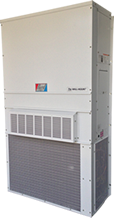
Bard wall-mount air conditioners are the most commonly modified unit in the explosion-proof air conditioning industry. If you are cooling a control room, analyzer shelter, MCC building, or equipment enclosure in a hazardous location at a US refinery or petrochemical plant, there is a strong chance the existing unit — or the unit that should be there — is a modified Bard.
We take standard Bard units and re-engineer them to meet the exact hazardous location classification your facility requires — Class 1 or Class 2, Division 1 or Division 2, any group. The modification is not a simple retrofit. It is a systematic replacement of every component that could serve as an ignition source, resulting in a unit that cools the space exactly like the original but cannot ignite the surrounding atmosphere.
Why Bard Is the Industry Standard for Explosion Proof Wall-Mount AC
Bard wall-mount units were not designed specifically for hazardous locations — but their industrial DNA makes them the natural starting point for explosion-proof fabrication. Several characteristics set them apart from other brands:
Self-contained design. Everything — compressor, condenser, evaporator, controls — is in a single sealed enclosure. There are no field-run refrigerant lines, no split connections, and no separate outdoor unit to coordinate. This makes the modification scope well-defined and keeps installation simple.
Wall-mount configuration. The unit installs through an exterior wall, with the evaporator inside the classified space and the condenser outside. This is the ideal configuration for explosion-proof applications because it naturally separates the indoor (classified) section from the outdoor (often non-classified) section — which directly affects cost.
Wide capacity range. Bard wall-mount units are available from fractional tonnage (3,600 BTU) up to 5 tons (60,000 BTU), covering the vast majority of industrial cooling applications for small to medium enclosures.
Industrial-grade construction. Bard units are already designed for outdoor installation, extreme temperatures, and demanding environments — telecommunications shelters, military installations, portable buildings. The base unit is robust enough to withstand the additional sealing, motor replacement, and enclosure work that explosion-proof modification requires.
Parts availability. Because Bard is the dominant platform in this application, replacement parts and components are more readily available than for less common brands. This matters for long-term maintenance and service.
What We Modify
Converting a Bard unit to explosion-proof specifications involves re-engineering every potential ignition source in the system:
Motor replacements. All motors — compressor, condenser fan, evaporator fan — are replaced with explosion-proof rated motors certified for your specific Class, Division, and Group. A motor rated for Class 1, Division 2, Group D is not the same as one rated for Class 1, Division 1, Group B — the engineering requirements differ substantially.
Sealed electrical enclosures. Every junction box, terminal block, contactor, and relay enclosure is replaced with explosion-proof rated hardware. These enclosures are engineered to contain any internal arc and prevent the surrounding flammable atmosphere from reaching an ignition source.
Rigid metallic conduit and sealing fittings. All standard wiring and flexible conduit is replaced with rigid metallic conduit. Explosion-proof sealing fittings are installed at every enclosure penetration point to prevent flame propagation through wiring pathways.
Coated coils. For corrosive environments — H₂S in refineries, salt air at coastal or offshore facilities, acidic atmospheres in chemical plants — evaporator and condenser coils are coated with Aqua-Aero or equivalent protective coating to prevent premature failure.
Custom enclosures. When the standard Bard enclosure does not meet classification requirements — or when the application demands stainless steel or specially coated materials — we fabricate custom enclosures to spec.
Surface temperature control. All surfaces are verified to remain below the autoignition temperature of the gases or vapors in the environment, per the required T-code rating.
Documentation. Every modified unit ships with documentation for your maintenance records and compliance files. Extended documentation packages are available for government, military, and major operator requirements.
Classification Options
We modify Bard units to meet any hazardous location classification under NEC Article 500:
-
Class 1, Division 2, Groups C & D — the most common request. Standard for oil refineries, petrochemical plants, natural gas facilities, and chemical plants where flammable vapors may be present under abnormal conditions. This is where the majority of our Bard modifications land.
-
Class 1, Division 1, Groups C & D — for areas where flammable gases or vapors are present continuously or under normal operating conditions. Division 1 requires more extensive modification and carries a higher price point.
-
Class 1, Groups B — for hydrogen-rich environments. Requires higher-rated motors and enclosures. Less common but achievable.
-
Class 2, Division 1 or 2, Groups E, F, G — for combustible dust environments including grain handling, pharmaceutical manufacturing, coal processing, and certain mining operations.
-
NEC Article 505 (Zone system) — if your facility uses Zone classification instead of Class/Division, we can match equipment to Zone requirements.
Not sure which classification your facility requires? Call us — we walk people through this every day, and we can usually help you determine the right spec in a 10-minute conversation.
Pricing
Explosion-proof Bard modifications are priced based on classification, unit size, and scope of work.
Class 1, Division 2, Group C&D — inside only (evaporator): Starting at $6,700 for smaller units, up to $7,600 for 3-ton units
Class 1, Division 2, Group C&D — full inside + outside: Starting at $9,000 for 8,000 BTU, approximately $10,000 for 3-ton units
Division 1 modifications: Add 20–40% over Division 2 pricing for the same unit size
5-ton units with full modification: Approximately $10,000–$12,000+ depending on classification and site requirements
These are starting-point figures. Final pricing depends on your specific classification, site conditions, and any custom fabrication needed. We provide firm quotes within 24–48 hours.
See our full pricing guide for a complete breakdown of what drives cost.
Bard vs. Other Unit Types
A Bard wall-mount is the right choice for most applications, but not all. Here is how it compares:
Bard wall-mount vs. mini split: Mini splits are the most affordable explosion-proof option available today and work well for loads up to about 3 tons. The difference is that mini splits require an indoor evaporator head mounted on a wall or ceiling inside the space. Bard wall-mounts are completely self-contained on the exterior — nothing inside except supply and return air openings. If interior space is at a premium, choose a Bard. If you have wall or ceiling space available and want the lowest cost, choose a mini split.
Bard wall-mount vs. split system: Bard units are self-contained and simpler to install. Split systems are necessary when the cooling load exceeds 5 tons or when wall penetration for a self-contained unit is not feasible. Split systems cost more due to additional components and more complex installation.
Bard wall-mount vs. pressurization: For a single control room or small shelter, a Bard wall-mount is almost always the more practical and less expensive option. Pressurization becomes the better choice for large buildings where explosion-proofing all interior equipment would be cost-prohibitive.
Any Brand, Any Spec
While Bard is our most frequently modified unit, we apply explosion-proof fabrication to virtually any brand of air conditioner — Trane, Carrier, Lennox, Mitsubishi, or others — when a customer brings us a specific unit requirement. If you have a brand preference or an existing unit that needs to be matched, we can work with it.
Request a Quote
The fastest way to get a quote is a phone call. Our team can usually give you a ballpark on the first call and turn a firm written quote around in 24–48 hours once we understand your classification and BTU requirements.
Call (844) 925-5668 or request a quote online.
Related Pages
- What Is an Explosion Proof Air Conditioner? — complete guide with classifications, pricing, and real installations
- How Much Does It Cost? — full pricing breakdown
- Explosion Proof Mini Splits — the most affordable option available today
- Explosion Proof Window Air Conditioners — currently unavailable due to refrigerant standards
- Explosion Proof Split Systems — for higher capacity or no-wall-penetration installs
- How to Choose an Explosion Proof Air Conditioner — step-by-step buyer’s guide
- Class 1, Division 2 Explained — the most common classification
- Class 1, Division 1 Explained — continuously hazardous areas
- Pressurization Systems — an alternative for large buildings
- Oil & Gas Applications — refinery and petrochemical installations
- FAQ — common questions