
Explosion Proof Mini Split Air Conditioners
Mini splits have become the most affordable way to put explosion-proof cooling into a hazardous location. They have effectively replaced window units as the budget-friendly entry point for classified spaces — delivering reliable cooling at a price point that makes compliant HVAC accessible for small enclosures, shelters, and control rooms.
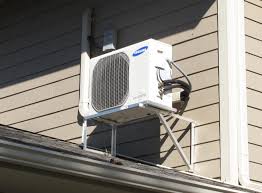
A mini split is exactly what the name implies: the system is split into two sections. A compact indoor evaporator head mounts on a wall or ceiling inside the classified space. An outdoor condenser unit mounts on an exterior wall, rooftop, or ground pad outside. The two sections are connected by refrigerant lines that run through a small penetration in the wall.
We modify mini splits from major manufacturers to meet your exact hazardous location classification — Class 1 or Class 2, Division 1 or Division 2, any group. Each section is independently rated to match the classification on its side of the wall.

Why Mini Splits Are the New Affordable Option
Window units were historically the least expensive path to explosion-proof cooling. Due to recent refrigerant standard changes, explosion-proof window units are currently unavailable industry-wide — the components needed to modify them to hazardous location standards cannot be sourced under the new refrigerant regulations.
Mini splits have stepped into that role and, in many ways, are a better product for the application:
Affordability. Mini split modifications start at price points comparable to where window units were, making them the most cost-effective explosion-proof cooling option available today.
Higher efficiency. Modern mini splits use inverter-driven compressors that are significantly more energy-efficient than the fixed-speed compressors in traditional window units. Lower operating costs over the life of the equipment.
Quieter operation. The compressor is in the outdoor unit, so the indoor head runs quietly — an advantage in control rooms where operators spend extended shifts.
Flexible capacity range. Mini splits are available from small fractional-ton units up to multi-ton capacities, covering the same range window units served and beyond.
Easier installation in retrofit situations. The indoor head mounts on any wall or ceiling surface. The refrigerant line penetration through the wall is small — typically a 3-inch hole rather than the large rectangular opening a window unit or wall-mount requires. This makes mini splits practical for structures where cutting a large wall opening is difficult or undesirable.
The Trade-Off: Indoor Space
The one thing a mini split requires that a Bard wall-mount does not is interior space. The indoor evaporator head — typically a slim rectangular unit — mounts on a wall or hangs from the ceiling inside the classified space. It is compact and usually installs high up near the ceiling where it is out of the way, but it does take up some interior real estate.
For most applications, this is not a problem. Control rooms, instrument shelters, and equipment enclosures typically have available wall or ceiling space for the indoor head.
If interior space is truly at a premium — for example, a tightly packed MCC building where every wall is occupied by equipment — a Bard wall-mount unit is the better choice. Bard wall-mounts are completely self-contained on the exterior of the building. You only need to cut a supply and return air opening through the wall for air circulation. Nothing protrudes into the interior space.
What We Modify
The explosion-proof modification process for a mini split covers both sections:
Indoor head (evaporator) — The fan motor is replaced with an explosion-proof rated motor certified for your Class, Division, and Group. All electrical connections, control boards, and wiring are enclosed in explosion-proof rated housings with sealed penetrations. Rigid metallic conduit replaces any standard wiring.
Outdoor unit (condenser) — Compressor, condenser fan motor, and all electrical components are replaced or enclosed with explosion-proof rated hardware. When the outdoor unit sits in a non-classified area, this section may not require full explosion-proof modification — reducing cost.
Refrigerant lines and wall penetration — All connections through the classified boundary are sealed per NEC requirements. Sealing fittings prevent flame propagation through the line penetration.
Controls — Thermostat, disconnect, and control wiring are rated for the classified environment. Standard wireless or IR remotes are replaced with hardwired, rated controls.
Documentation — Full documentation package for maintenance records and compliance files.
Classification Options
We modify mini splits for any hazardous location classification:
- Class 1, Division 2, Groups C & D — the most common configuration for refineries, petrochemical facilities, and chemical plants
- Class 1, Division 1, Groups C & D — for areas where flammable gases are present continuously or under normal operating conditions
- Class 2, Division 1 or 2, Groups E, F, G — for combustible dust environments including grain handling, pharmaceutical manufacturing, and mining
- Mixed classifications — indoor and outdoor units rated independently to match the actual conditions on each side
Pricing
Mini split modifications are priced based on classification, capacity, and scope of work.
Class 1, Division 2, Group C&D — indoor unit only (condenser in non-classified area): Starting at approximately $6,700 for smaller units, scaling with capacity.
Class 1, Division 2, Group C&D — full indoor + outdoor modification: Starting at approximately $9,000+ depending on capacity and configuration.
Division 1 modifications: Add 20–40% over Division 2 pricing.
These are starting-point figures. Final pricing depends on the specific manufacturer, model, classification, and any custom requirements. We provide firm quotes within 24–48 hours.
See our full pricing guide for a complete breakdown of what drives cost.
Mini Split vs. Bard Wall-Mount: Which One?
This is the most common question we get from customers who previously would have chosen a window unit. Here is how to decide:
Choose a mini split if:
- You have available wall or ceiling space inside for the indoor head
- You want the most affordable explosion-proof cooling option
- Energy efficiency and quiet operation matter (control rooms with operators)
- The structure makes it difficult to cut a large wall opening (the mini split only needs a small refrigerant line penetration)
- You are in a retrofit situation where the existing wall opening does not fit a self-contained unit
Choose a Bard wall-mount if:
- Interior space is at a premium and you cannot accommodate an indoor unit on the wall or ceiling
- You prefer a completely self-contained system with nothing inside except supply and return air openings
- You need higher capacity (Bard wall-mounts go up to 5 tons)
- The installation environment is extremely demanding (extreme heat, heavy vibration, highly corrosive) — Bard units are built for industrial abuse from the factory
Not sure? Call us at (844) 925-5668 — we can help you figure out the right approach for your specific application in a 10-minute conversation.
Mini Split vs. Full Split System
Mini splits and full split systems both separate the indoor and outdoor components, but they serve different applications:
Mini splits are designed for smaller cooling loads — typically up to 2–3 tons. The indoor head is compact and wall or ceiling mounted. Installation is simpler and cost is lower.
Full split systems are designed for larger cooling loads — 3 tons and up, with no practical upper limit. The indoor unit is a larger air handler that may require floor space or a dedicated mechanical closet. Installation is more complex and cost is higher.
If your cooling load is under 3 tons, a mini split is almost always the better value. Above 3 tons, a full split system becomes necessary.
Request a Quote
Tell us your classification, approximate cooling load, and whether the outdoor unit is in a classified area. We will have a quote back to you within 24–48 hours.
Call (844) 925-5668 or request a quote online.
Related Pages
- What Is an Explosion Proof Air Conditioner? — complete guide with classifications, pricing, and real installations
- Explosion Proof Bard Air Conditioners — wall-mount units, completely self-contained on the exterior
- Explosion Proof Split Systems — for higher capacity requirements
- Explosion Proof Window Air Conditioners — currently unavailable due to refrigerant standards
- How Much Does It Cost? — full pricing breakdown
- How to Choose an Explosion Proof Air Conditioner — step-by-step buyer’s guide
- Class 1, Division 2 Explained — the most common classification
- Pressurization Systems — an alternative for large buildings
- FAQ — common questions about explosion-proof AC