
Explosion Proof Split System Air Conditioners
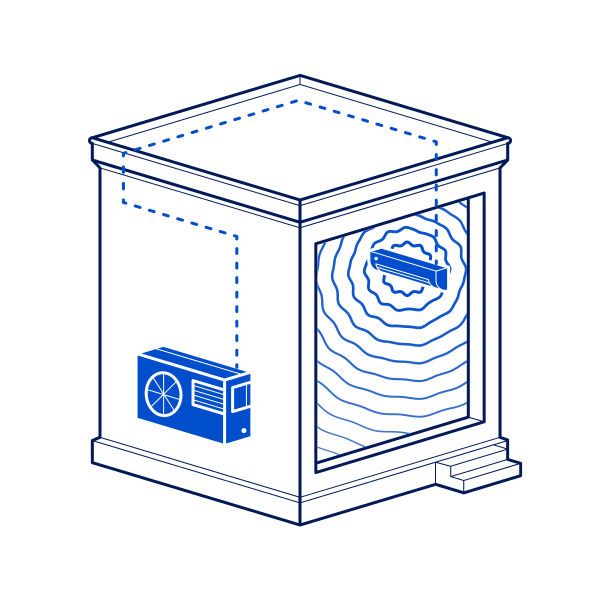
When a wall-mount or window unit can’t deliver the cooling capacity your classified space requires — or when wall penetration isn’t feasible — a split system is the answer. Split systems separate the indoor evaporator from the outdoor condenser, connected by refrigerant lines, giving you flexibility in placement and access to higher tonnage ranges that self-contained units can’t reach.
We modify split systems from major manufacturers to meet your exact hazardous location classification, with the indoor and outdoor sections independently rated to match the conditions on each side of the wall.
When Does a Split System Make Sense?
Most explosion-proof cooling applications start with a wall-mount or window unit. A split system becomes the right call when:
You need more capacity. Wall-mount and window units top out around 5 tons. Split systems can deliver significantly higher cooling loads — critical for larger control rooms, equipment shelters, or process areas with heavy heat-generating equipment.
Wall penetration isn’t possible. Some structures — blast-resistant modules, reinforced concrete shelters, or retrofit situations — don’t allow cutting a wall opening for a self-contained unit. A split system only requires small refrigerant line penetrations.
Indoor and outdoor areas have different classifications. A split system lets you spec each section independently. The indoor unit might need Class 1, Division 1 while the outdoor condenser sits in a Division 2 or non-classified area. You only pay for the level of modification each section actually requires.
You need remote condenser placement. The outdoor unit can be located a significant distance from the indoor unit — on a roof, on grade, or in a mechanical yard — giving you layout flexibility that self-contained units can’t offer.
What We Modify
An explosion-proof split system modification covers both the indoor and outdoor sections, tailored to the classification each one requires:
Indoor unit (evaporator) — Explosion-proof rated motors, sealed electrical penetrations, conduit fittings rated to your Class/Division/Group. Coated coils where corrosion resistance is needed.
Outdoor unit (condenser) — Same treatment as the indoor unit when located in a classified area. When the condenser sits in a non-classified zone, this section may not require explosion-proof modification — saving cost.
Refrigerant lines and connections — All field connections and penetrations sealed to meet NEC requirements for your classification.
Controls and wiring — Thermostats, disconnects, and control wiring rated for the classified environment. Junction boxes and enclosures replaced or upgraded as required.
Documentation — Full documentation package for your maintenance records and compliance files.
Classification Options
Split systems can be modified for any hazardous location classification:
- Class 1, Division 2, Groups C & D — the most common configuration for refineries, petrochemical facilities, and chemical plants where flammable vapors may be present under abnormal conditions
- Class 1, Division 1, Groups C & D — for areas where flammable gases or vapors are present continuously or under normal operating conditions
- Class 2, Division 1 or 2 — for dust-ignitable environments including grain handling, pharmaceutical manufacturing, and mining operations
- Mixed classifications — indoor and outdoor units rated independently to match the actual conditions on each side
Pricing
Split system modifications are priced based on the classification requirements for each section, total capacity, and scope of work.
Class 1, Division 2, Group C&D (indoor unit only — condenser in non-classified area): Starting at approximately $9,000 for smaller systems, scaling with tonnage.
Class 1, Division 2, Group C&D (full indoor + outdoor modification): Starting at approximately $13,000+ depending on capacity and configuration.
Division 1 and special classifications carry additional cost due to more extensive modification requirements.
These are ballpark figures to help you plan. Final pricing depends on the specific manufacturer, model, classification, and any custom fabrication. We provide firm quotes within 24–48 hours.
Split System vs. Wall-Mount: Which One?
If your cooling load is under 5 tons and you can cut a wall opening, a Bard wall-mount unit is almost always the more cost-effective choice. Wall-mounts are self-contained, easier to install, and have a smaller footprint.
Choose a split system when you need more than 5 tons of cooling, when wall penetration isn’t possible, or when the indoor and outdoor environments have different classification requirements.
Not sure which direction to go? Call us — we’ll help you figure out the right approach for your application.
Request a Quote
Tell us your classification requirements, approximate cooling load (BTU or tonnage), and the installation scenario. We’ll turn a quote around in 24–48 hours.
Request a Quote or call (844) 925-5668 directly.
Related Pages
- What Is an Explosion Proof Air Conditioner? — complete guide with classifications, pricing, and real installations
- Explosion Proof Bard Air Conditioners — wall-mount units, the most common modification
- Explosion Proof Mini Splits — the most affordable option available today
- Explosion Proof Window Air Conditioners — currently unavailable due to refrigerant standards
- How Much Does It Cost? — full pricing breakdown across all unit types
- How to Choose an Explosion Proof Air Conditioner — step-by-step buyer’s guide
- Pressurization Systems — an alternative for large buildings
- Class 1, Division 1 Explained — understand Division 1 requirements
- Class 1, Division 2 Explained — the most common classification
- FAQ — common questions about explosion-proof air conditioning