
If Your Building Can Be Pressurized, You May Not Need Explosion-Proof Equipment Inside It

Full explosion-proof buildouts are expensive — and often unnecessary. Purge and pressurization is a code-compliant alternative under NFPA 496 that lets you declassify the interior of a building by maintaining positive air pressure with clean, above-grade intake air. The result: standard (non-XP) cooling and electrical equipment inside, one explosion-proof condenser outside, and a system that satisfies the National Electrical Code without equipping every component for a classified location.
Roughly 20–25% of our customers choose pressurization. The reason is simple math: while the pressurization system itself is a significant investment ($25,000–$50,000), it eliminates the need for explosion-proof rated equipment throughout the entire building interior — switchgear, lighting, HVAC, instrumentation — each of which carries a 3–10× cost premium over its standard-rated equivalent. The pressurization system typically pays for itself many times over. It can also be added to any existing air conditioning unit or supplied as a standalone pressurization module.
This is not a workaround. It is the specified, standards-backed approach — and for the right application, it substantially reduces the cost and complexity of your hazardous location buildout.
What Pressurization Does — and Why It Works
Classified areas (Class I Div 1 and Div 2) are dangerous because flammable vapors or gases may be present in concentrations sufficient to ignite. The NEC’s default response is to require explosion-proof equipment rated for that specific location throughout.
Pressurization takes a different approach: instead of making every piece of equipment inside the building explosion-proof, you prevent the classified atmosphere from entering the building at all. By maintaining continuous positive pressure inside the structure with clean air, you create a physical barrier. The flammable atmosphere cannot infiltrate against the outward airflow.
Under NFPA 496, a properly pressurized enclosure is considered to have its internal classification reduced or eliminated — depending on the protection type applied. The equipment inside is no longer operating in a classified atmosphere. Standard-rated equipment can be used lawfully.
The logic is straightforward: if you can guarantee flammable atmosphere never reaches the equipment, the equipment doesn’t need to be rated for it.
How the System Works
A complete purge and pressurization system has five interdependent components. Every one of them matters.
1. The Snorkel Air Intake
This is the element most specifiers don’t anticipate — and it’s critical to the safety case.
Ground-level air near refineries, chemical plants, and processing facilities may contain flammable vapor concentrations. You cannot use that air to pressurize a building and claim your intake supply is clean. The solution is a tall vertical galvanized duct — the “snorkel” — that rises well above grade (typically 20–25 feet) to draw intake air from above the potential vapor cloud. At that elevation, the air is reliably free of ground-level accumulations.
The snorkel is spiral-wound galvanized steel, topped with a rain cap to exclude precipitation and debris, and braced with guy wires to handle wind loads at height. It is not optional — it is the foundation of the clean-air guarantee the pressurization system depends on.
2. The Pressurization Unit
The pressurization unit draws air through the snorkel and forces it into the building at positive pressure. The system maintains a continuous pressure differential — outward — so classified atmosphere cannot infiltrate through gaps, penetrations, or door seals. Modern systems include continuous pressure monitoring with alarm outputs.
3. The Explosion-Proof Condenser (Outside)
The AC condenser — the section of the cooling system that rejects heat to the outdoors — sits outside the building in the classified area. It must be fully XP-rated for the Class, Division, and Group of the location where it’s installed. This is the one component in our system that is explosion-proof in the traditional sense.
Our manufacturing team builds these condensers to your location’s specific classification. Ratings depend on the chemical or gas present: Groups B, C, D for hydrogen, ethylene, propane, and similar; Groups E, F, G for dust environments. (We do not cover Group A — acetylene — locations.)
4. Standard Cooling Equipment Inside
Because the interior of the building is declassified by the pressurization system, the evaporator coil, air handler, and associated electrical controls can be standard commercial-grade equipment. No XP rating required inside a properly maintained pressurized structure. This is where the economics of pressurization become compelling.
5. The Pressurization Alarm System
NFPA 496 mandates a continuous pressure-monitoring system with an audible/visual alarm that activates when pressurization is lost. This is the red alarm horn you’ll see on every compliant installation — it’s not decorative. If pressure drops below the required differential, the alarm fires before classified atmosphere can accumulate to dangerous concentrations inside the building.
Depending on the protection type (see NFPA 496 Types X, Y, Z below), the system may also be required to automatically de-energize equipment or prevent startup when pressurization is insufficient.
A Real Installation
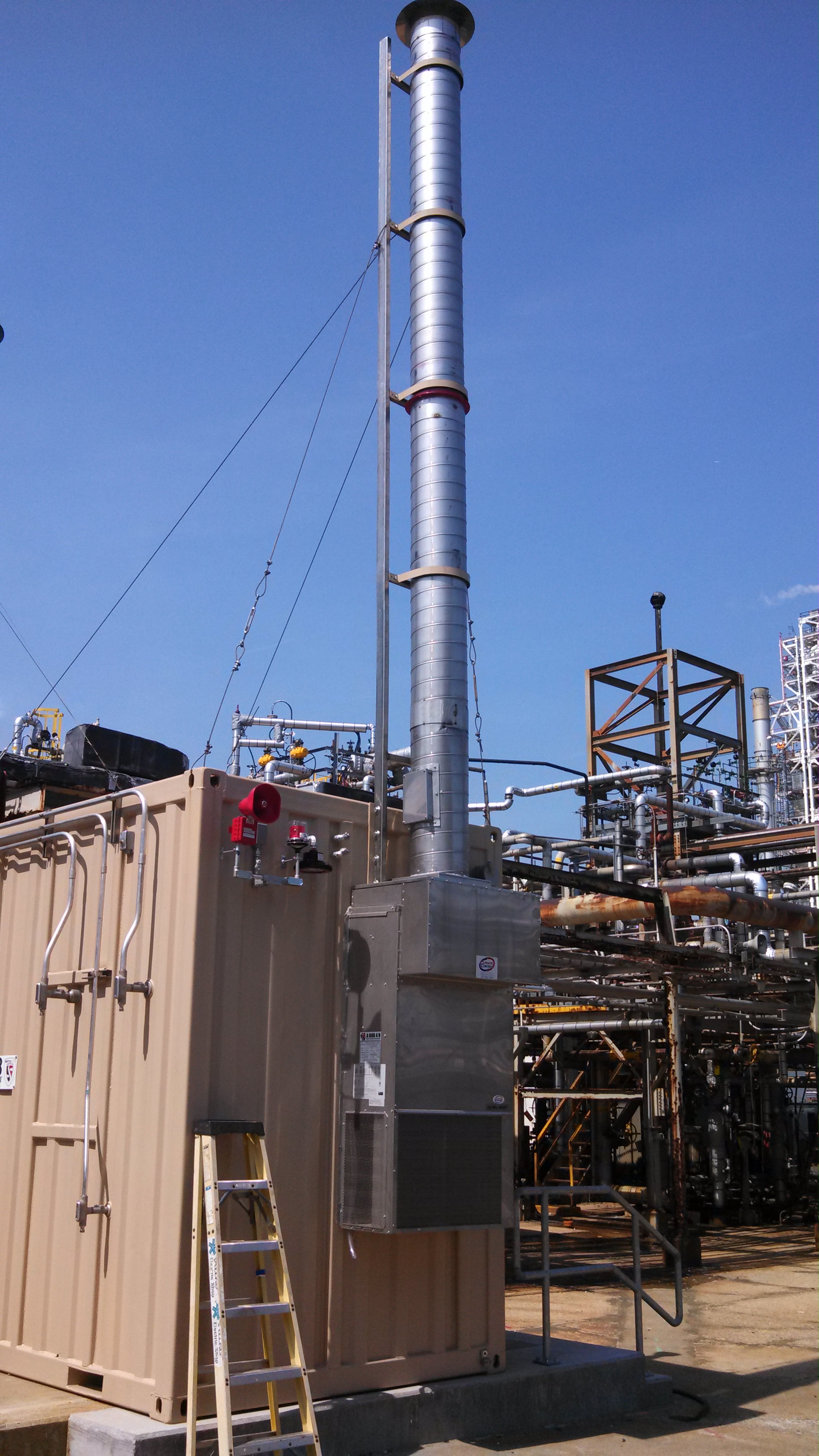
What you’re looking at: A tan/beige containerized equipment shelter at an outdoor petrochemical facility. On the right rear corner, a silver galvanized wall-mount AC unit handles cooling and pressurization for the building interior. The dominant feature is the spiral-wound galvanized snorkel duct rising approximately 20 feet above the container roof, topped with a rain cap and braced with guy wires for wind stability — this is the clean-air intake, drawing from well above grade where vapor accumulation is not a risk. Mounted on the container wall is the red audible/visual alarm horn required by NFPA 496 — it fires if pressurization is lost. In the background: refinery pipe racks, yellow steel platforms, process piping. This is the actual working system, not a rendering.
When Pressurization Makes Sense
Pressurization is not the right answer for every classified-area application. It’s the right answer when:
The building is large enough — Pressurizing a small control enclosure (a panel or junction box) is typically handled with Type Z enclosure pressurization. For a full building — a portable equipment shelter, a modular substation, a prefabricated control room — purge and pressurization is where the economics work decisively in your favor.
The cost calculus favors it — Every piece of equipment in a fully XP-rated building carries a 3–10× cost premium over its standard-rated equivalent. Switchgear, lighting, HVAC, instrumentation — it adds up fast. If your building contains significant electrical or mechanical equipment, the cost of the pressurization system (see pricing below) is often a fraction of what full XP equipment would cost throughout.
You’re doing a new build — Retrofitting pressurization into an existing structure requires careful evaluation of the building envelope (sealing penetrations, qualifying door seals, ensuring structural integrity at differential pressure). New builds can be designed for pressurization from the start, which is simpler and less expensive.
The intake location can be clean — If there’s no practical way to locate a snorkel intake above the vapor cloud — for example, in an enclosed or low-ceiling structure surrounded by heavy process equipment — pressurization may not be achievable to NFPA 496 requirements. An open outdoor site with clear vertical clearance is the ideal application.
The alternative is full XP throughout — If the choice is between (a) a pressurized building with one XP condenser outside, or (b) a fully XP-rated building with XP-rated everything inside, pressurization is almost always the better answer on cost.
NFPA 496 — Types X, Y, and Z
NFPA 496 (Standard for Purged and Pressurized Enclosures for Electrical Equipment, current edition) defines three protection types based on the severity of the hazard being protected against:
Type X — Reduces the classification inside the protected enclosure from Division 1 to nonhazardous. Requires automatic de-energization of equipment (or personnel alarm with manual de-energization) upon loss of pressurization. Used when the protected space is in a Div 1 location and the goal is full declassification. This is the most rigorous protection level.
Type Y — Reduces the classification inside from Division 1 to Division 2 (not to nonhazardous). Requires an alarm upon pressure loss, but does not require automatic de-energization. Equipment inside still needs to be rated for Division 2 operation. Used when full declassification is not required or when the equipment inside has a Division 2 rating.
Type Z — Reduces the classification inside from Division 2 to nonhazardous. Requires an alarm upon pressure loss. This is the lowest-level NFPA 496 protection and is most commonly applied to individual enclosures or panels in Div 2 locations.
For full-building pressurization applications in Division 1 areas — the most common scenario for a portable equipment shelter at a refinery or chemical plant — Type X is typically the required protection level. Our specialists will help you confirm the correct type for your specific location classification before anything is designed or quoted.
What We Supply
We build complete pressurization systems for classified-area buildings. What’s included:
- Explosion-proof condensing unit — XP-rated for your specific Class, Division, and Group (Groups B, C, D for gases/vapors; Groups E, F, G for dusts; Group A not covered). Designed for the outdoor classified area where it will be installed.
- Pressurization unit — sized for your building volume and infiltration characteristics, with continuous pressure monitoring output.
- Snorkel air intake assembly — spiral-wound galvanized steel duct, sized to your system’s intake requirements, with rain cap and guy-wire attachment points. Supplied in modular sections for field assembly and height adjustment.
- NFPA 496-compliant alarm system — audible/visual alarm (red horn/strobe) with pressure switch and wiring. Type X installations include automatic de-energization output or manual-alarm circuit per project requirements.
- Standard cooling equipment for the interior — evaporator coil, air handler, and controls sized for your heat load. Standard-rated (not XP) because the building interior is declassified by the pressurization system.
Our specialists will ask for your building dimensions, heat load estimate, site classification (Class, Division, Group), and intake elevation. We can work from drawings or from a site description if drawings aren’t available yet. Lead time varies by system complexity — typically 8–14 weeks ARO for a complete system.
Pricing
A complete building pressurization system — XP condenser, pressurization unit, snorkel intake, alarm integration, and interior cooling — is a significant capital investment. Depending on building size, heat load, required protection type, and site-specific factors, expect a range of $25,000 to $50,000 or more for a complete system.
That range is meaningful: smaller shelters in Division 2 locations with modest heat loads come in near the lower end; larger buildings, Division 1 locations with Type X requirements, and high-heat-load applications push toward the upper end and beyond.
For context: if a full XP-rated buildout for a mid-size equipment shelter runs $150,000–$200,000 in XP-rated equipment alone, a $35,000–$50,000 pressurization system with standard equipment inside is a straightforward economic case.
We quote every project individually. There’s no standard catalog price for these systems because the variables matter too much to give a number that’s reliable without a design basis.
Get a Quote — 24 to 48 Hours
Tell us what you have: building dimensions, location classification, heat load if you know it, and intake elevation available. We’ll come back with a system recommendation and ballpark pricing, typically within 24–48 hours.
Request a Quote — or call us directly. Our specialists handle classified-area applications every day. There’s no long intake form, no waiting for a distributor to relay your question. You’re talking to the people who build the system.
Related Pages
- What Is an Explosion Proof Air Conditioner? — complete guide with classifications, pricing, and real installations
- How Much Does It Cost? — full pricing breakdown across all unit types
- How to Choose an Explosion Proof Air Conditioner — step-by-step buyer’s guide
- Explosion Proof Bard Air Conditioners — wall-mount units, our most common modification
- Explosion Proof Mini Splits — the most affordable option available today
- Explosion Proof Split Systems — for higher capacity installs
- Oil & Gas Applications — our most common pressurization customer
- Chemical Plant Applications — complex classification environments
- Military & Government — DOD and DOE installations
- FAQ — common questions about explosion-proof air conditioning
- Get a Quote — most quotes in 24–48 hours