
What Is an Explosion Proof Air Conditioner?
An explosion-proof air conditioner is a standard air conditioning unit that has been modified — or in some cases purpose-built — so that it cannot ignite flammable gases, vapors, or combustible dust in the surrounding environment.
The name is misleading. An explosion-proof air conditioner is not designed to survive an explosion. It is designed to prevent one. Every electrical component that could produce a spark or reach a dangerous surface temperature is replaced, sealed, or enclosed so that the unit can operate safely in an atmosphere where a single ignition source could be catastrophic.
This matters because air conditioners contain exactly the kind of electrical components that industrial safety codes are designed to control: motors that arc, relays that switch, contactors that spark. In a normal office or warehouse, those components are harmless. In a refinery, a chemical plant, a grain elevator, or a mine — anywhere the atmosphere may contain flammable gases, vapors, or combustible dust — they are a legitimate ignition risk.
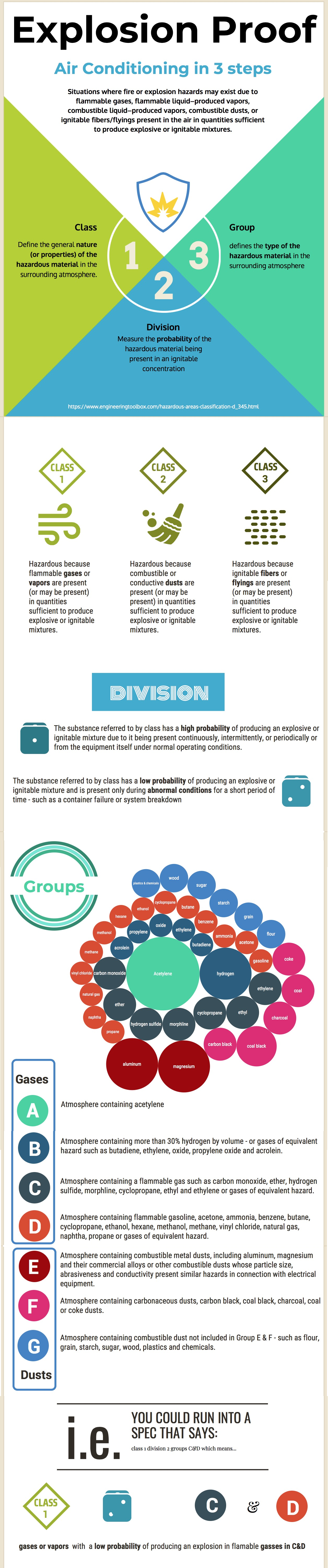
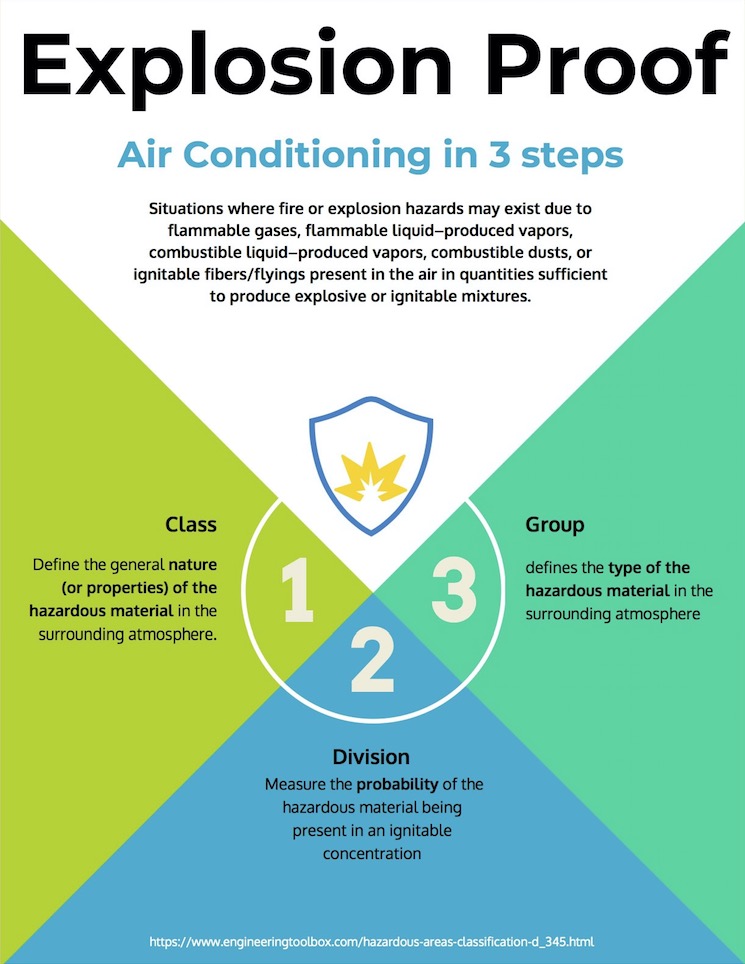
The National Electrical Code (NEC) addresses this through hazardous location classification, a system that identifies environments where flammable or combustible materials may be present and requires that all electrical equipment in those areas meet specific safety ratings. An explosion-proof air conditioner is a unit that meets those ratings.
If you already know your classification and just need a quote, call (844) 925-5668 — we return most quotes within 24–48 hours. If you’re still figuring out what you need, this guide covers everything.
In this guide:
- Why Standard AC Is a Hazard in Industrial Environments
- How Explosion Proof Air Conditioning Works
- Hazardous Location Classifications Explained
- Types of Explosion Proof Air Conditioners
- How to Choose the Right Unit for Your Application
- Pricing: What Explosion Proof AC Actually Costs
- Real-World Applications and Installations
- Common Questions and Misconceptions
- Getting Started: How to Get a Quote
Why Standard AC Is a Hazard in Industrial Environments
A conventional air conditioner contains several electric motors — typically a compressor motor, a condenser fan motor, and an evaporator fan motor. Under normal operation, these motors produce small electrical arcs at their brushes and commutators, and their surfaces can reach temperatures well above the autoignition point of many industrial gases and vapors.
In a standard commercial or residential building, this is harmless. There is nothing in the surrounding air that can ignite. But in facilities that process, store, or transport flammable materials, the atmosphere itself can become fuel. A spark that is invisible and inconsequential in an office building can trigger a catastrophic explosion in a refinery control room.
This is not theoretical. Industrial facilities have strict hazardous area classification programs specifically because the consequences of an uncontrolled ignition source are severe — injury, death, facility destruction, and environmental damage. Every piece of electrical equipment installed in a classified area must be rated for the specific hazard present, and air conditioning is no exception.
The challenge is that air conditioning equipment is inherently electrical, inherently mechanical, and inherently produces the two things that ignite flammable atmospheres: sparks and heat. An explosion-proof modification eliminates both risks through a specific set of engineering controls.
How Explosion Proof Air Conditioning Works
Converting a standard air conditioner into an explosion-proof unit is not a simple retrofit. It is a systematic re-engineering of every component that could serve as an ignition source. The process involves four primary modifications:
Explosion-Proof Motors
Every motor in the unit — compressor, condenser fan, evaporator fan — is replaced with an explosion-proof rated motor. These motors use heavy, machined enclosures with precisely controlled flame paths. If an internal arc occurs inside the motor housing, the enclosure contains the resulting pressure and cools any escaping gases below the ignition temperature of the surrounding atmosphere before they exit through the flame path.
The motor must be rated for the specific Class, Division, and Group of the installation. A motor rated for Class 1, Division 2, Group D (the most common refinery classification) is not automatically suitable for a Class 1, Division 1, Group B application — the engineering requirements are substantially different.
Sealed Electrical Enclosures
All electrical junction boxes, control panels, contactors, relays, and terminal blocks are replaced with explosion-proof rated enclosures. Like the motors, these enclosures are designed to contain any internal arc or spark and prevent the surrounding flammable atmosphere from entering the enclosure and reaching an ignition source.
Every bolt, cover, and gasket on these enclosures is part of the containment system. This is why explosion-proof equipment looks heavier and more industrial than standard equipment — the enclosures are engineered to withstand internal pressure events.
Rigid Metallic Conduit and Sealing Fittings
Standard flexible wiring and plastic conduit are replaced with rigid metallic conduit throughout the unit. At every point where conduit enters an enclosure, explosion-proof sealing fittings are installed. These fittings are packed with a sealing compound that prevents flame propagation along the wiring pathway.
This is critical because without sealed conduit, a flame front could travel from one enclosure to another through the wiring pathway — effectively bypassing the containment design of individual enclosures.
Surface Temperature Control (T-Codes)
Every surface on the unit — motor housings, compressor shells, conduit, enclosures — must remain below the autoignition temperature of the gases or vapors in the environment. Explosion-proof equipment is rated with temperature codes (T-codes, from T1 through T6) that certify the maximum surface temperature under the worst-case operating conditions.
For example, a unit rated T3 (200°C / 392°F maximum surface temperature) is suitable for atmospheres containing gasoline vapor (autoignition temperature 280°C) but would not be suitable for carbon disulfide (autoignition temperature 90°C, requiring T5 or T6 equipment). Getting the T-code right is as important as getting the Class and Division right.
The result of all four modifications: an air conditioner that cools the space exactly like a standard unit, but cannot ignite the atmosphere — even if flammable concentrations of gas, vapor, or dust are present.
Hazardous Location Classifications Explained
The NEC uses a classification system to define hazardous environments. Every explosion-proof air conditioner must be matched to the specific classification of the area where it will be installed. Getting this wrong — installing equipment rated for one classification in an area that requires another — is a code violation and a safety failure.
Class: What Is the Hazard?
The Class identifies the type of hazardous material present:
Class 1 — Flammable Gases and Vapors. The atmosphere may contain flammable gases or vapors — petroleum products, natural gas, hydrogen, solvents, alcohols. This is the most common classification in oil and gas, petrochemical, and chemical manufacturing facilities.
Class 2 — Combustible Dust. The atmosphere may contain combustible dust — grain dust, coal dust, pharmaceutical powders (API), metal dust, plastic dust. Common in grain handling, mining, pharmaceutical manufacturing, and metalworking.
Class 3 — Ignitable Fibers and Flyings. The atmosphere may contain ignitable fibers or flyings — cotton lint, wood shavings, textile fibers. Common in textile mills, woodworking, and cotton processing. Class 3 is less common for air conditioning applications.
Division: How Likely Is the Hazard?
The Division defines the probability that the hazardous material will actually be present in the atmosphere:
Division 1 — Normal conditions. The hazard is present continuously, intermittently, or periodically under normal operating conditions. Division 1 locations include areas inside process vessels, near relief valves, and in spaces where hazardous materials are handled as part of daily operations. Division 1 requires the most stringent equipment ratings.
Division 2 — Abnormal conditions only. The hazard is not present under normal operating conditions but may be present during equipment failure, maintenance, or process upsets. Division 2 is the more common classification for most industrial air conditioning applications because the air conditioner is typically cooling an adjacent control room or shelter — not the process area itself.
The practical difference: Division 1 modification is more extensive and more expensive than Division 2. Many industrial facilities have both Division 1 and Division 2 areas, with the air conditioner itself often mounted on the boundary between classified and non-classified space.
Group: What Specific Material?
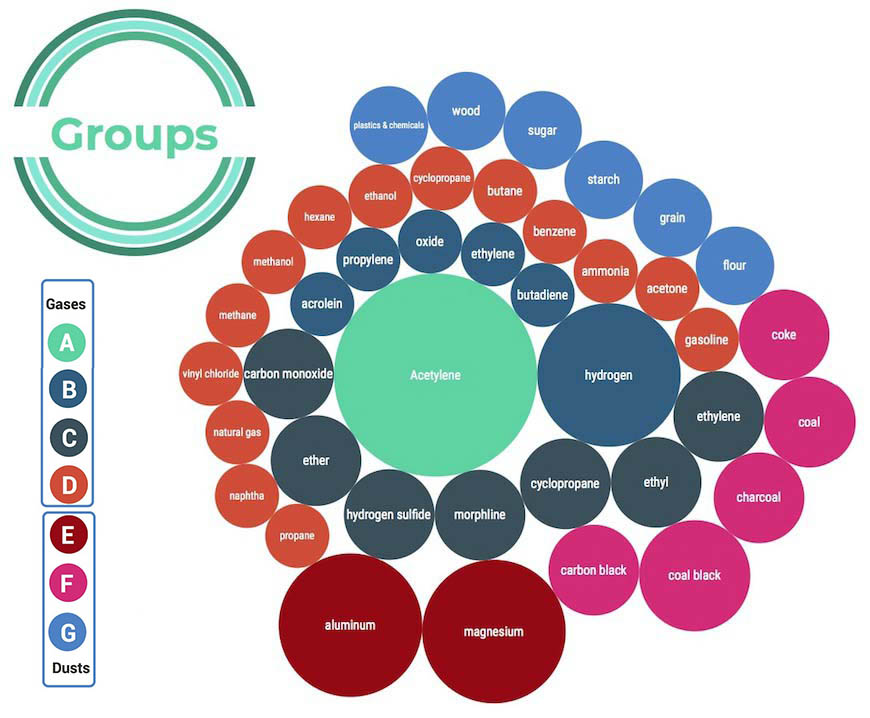
The Group narrows the hazard to a specific category of material, each with its own ignition characteristics:
Class 1 Groups (gases and vapors):
- Group A — Acetylene (extremely reactive; very few modifiers work with Group A)
- Group B — Hydrogen, butadiene, ethylene oxide, propylene oxide
- Group C — Ethylene, ethyl ether, cyclopropane
- Group D — Gasoline, propane, natural gas, methane, acetone, ammonia, benzene
Groups C and D account for the vast majority of explosion-proof air conditioning applications. If you are at a refinery, chemical plant, or natural gas facility, your classification is very likely Class 1, Division 2, Groups C & D.
Class 2 Groups (dusts):
- Group E — Combustible metal dusts (aluminum, magnesium)
- Group F — Combustible carbonaceous dusts (coal, carbon black, charcoal)
- Group G — Other combustible dusts (grain, flour, wood, plastic, pharmaceutical powders)
NEC Article 500 vs. Article 505 (Zone System)
The United States primarily uses the Class/Division system under NEC Article 500. Some facilities — particularly those designed by international engineering firms — use the Zone system under NEC Article 505, which divides hazardous areas into Zone 0, Zone 1, and Zone 2 instead of Division 1 and Division 2.
The Zone system provides slightly finer granularity (Zone 0 has no Division equivalent), but for air conditioning applications the practical effect is similar. If your facility uses Zone classification, we can match equipment to Zone requirements. The international equivalents (ATEX and IECEx) use a similar zone-based approach.
Types of Explosion Proof Air Conditioners
Not all explosion-proof installations look the same. The right unit configuration depends on the physical constraints of your facility, the size of the space being cooled, and the classification boundary.
Wall-Mount (Through-the-Wall) Units
The most common configuration for industrial hazardous location cooling. A self-contained unit installs through an exterior wall, with the evaporator (cooling) section inside the classified space and the condenser section outside.
Best for: Control rooms, analyzer shelters, small equipment buildings, telecom shelters, and any application where you can cut a wall opening. Available from fractional-ton (3,600 BTU) to 5 tons (60,000 BTU).
Why it’s popular: Self-contained design means no refrigerant line connections in the field. Compact footprint. Bard wall-mount units are the most frequently modified base unit in the industry — their industrial-grade construction makes them a natural fit for explosion-proof fabrication.
Learn more about Bard wall-mount units →
Mini Split Systems
Mini splits have become the most affordable way to cool a hazardous location. An indoor evaporator head mounts on a wall or ceiling inside the classified space, and the outdoor condenser mounts on the exterior. The two sections connect through a small refrigerant line penetration — no large wall opening required.
Best for: Budget-conscious applications, small to medium enclosures, control rooms, retrofit situations where cutting a large wall opening is impractical. Typical capacity range up to 3 tons.
Trade-off: The indoor head takes up some wall or ceiling space inside the structure. If interior space is at an absolute premium, a Bard wall-mount (which is completely self-contained on the exterior) may be the better choice.
Learn more about mini splits →
Window and Through-Wall Units (Small)
Window units were historically the most affordable explosion-proof cooling option. Due to new refrigerant standards, explosion-proof window units are currently unavailable industry-wide. Mini splits have effectively replaced them as the budget-friendly option.
Learn more about window units →
Split Systems
Indoor evaporator and outdoor condenser are separate units connected by refrigerant lines. Each section can be independently rated for its classification area.
Best for: Higher cooling capacities (above 5 tons), installations where wall penetration for a self-contained unit is not possible, and situations where the indoor and outdoor sections are in different classification zones.
Trade-off: More refrigerant line penetrations to seal, which adds to modification cost. More complex installation. But split systems unlock capacity ranges that self-contained units cannot reach.
Learn more about split systems →
Pressurized and Purged Systems
An alternative approach that uses positive air pressure to keep flammable atmosphere out of an enclosure, allowing the use of standard (non-explosion-proof) equipment inside. An explosion-proof condenser sits outside, and a snorkel intake pulls clean air from above the classified zone to maintain pressurization.
Best for: Large buildings or shelters where the cost of explosion-proofing all HVAC equipment inside would be prohibitive. Pressurization can reduce the total project cost by 60–80% compared to making every component explosion-proof.
Governed by: NFPA 496, which defines three purge types — Type X (reduces Division 1 to non-hazardous), Type Y (reduces Division 1 to Division 2), and Type Z (reduces Division 2 to non-hazardous).
Learn more about pressurization →

How to Choose the Right Unit for Your Application
Selecting an explosion-proof air conditioner is a structured decision. You need five pieces of information before you can get an accurate quote.
Step 1: Know Your Classification
This is non-negotiable. You must know the Class, Division, and Group for the area where the air conditioner will be installed. This information comes from your facility’s Hazardous Area Classification (HAC) drawings — part of the electrical design documentation that every classified facility is required to maintain.
If you don’t have HAC drawings or are unsure of your classification, a qualified electrical engineer needs to classify the area under NEC Article 500 (or 505). This is not something to estimate or guess at. An incorrect classification means the wrong equipment specification, which is both a code violation and a safety hazard.
The most common answer: If you are at an oil refinery, petrochemical plant, or natural gas facility, your classification is very likely Class 1, Division 2, Groups C & D. This covers the majority of our work.
Step 2: Size the Cooling Load
How much cooling does the space require? The answer comes from a heat load calculation based on:
- Space dimensions — square footage and ceiling height
- Heat-generating equipment — servers, VFDs, motor control centers, analyzers, electrical panels
- Solar exposure — direct sun on the structure adds significant load, especially in southern climates
- Ambient temperature — desert sites, Gulf Coast humidity, and northern cold all affect sizing differently
- Target indoor temperature — most industrial applications target 85–95°F, not the 72°F of an office
Common ranges: 1 ton (12,000 BTU) for a small instrument shelter, 2–3 tons for a typical control room, 5 tons for a larger equipment building. Larger applications (modular buildings, pressurized shelters) can reach 10–20+ tons.
Not sure of your load? Give us the space dimensions and a list of heat-generating equipment inside, and we can help you estimate.
Step 3: Determine the Classification Boundary
This is the question that most directly affects cost: does only the indoor section of the air conditioner need to be explosion-proof, or do both the indoor and outdoor sections?
Inside only (evaporator): The wall the unit mounts through separates the classified area from a non-classified area. Only the evaporator side — the part inside the classified space — needs explosion-proof modification. The condenser sits in clean air. This is the most common and most affordable configuration.
Full inside + outside: Both sides of the unit are within the classified area. Both sections require explosion-proof modification. Required for equipment shelters entirely within a process area, blast-resistant modules, or any installation where the condenser cannot be located outside the classification boundary.
The cost difference is significant — typically 30–40% more for full inside + outside modification versus inside only.
Step 4: Pick the Unit Type
Based on your cooling load and installation constraints:
- Under 3 tons + budget-sensitive → Mini split (most affordable option)
- Under 5 tons + no interior space available → Wall-mount (Bard) (self-contained on exterior)
- Over 5 tons or no wall opening → Split system
- Large building + want to minimize XP equipment → Pressurization
Step 5: Consider Site Conditions
Beyond classification, environmental factors affect the specification:
Corrosive atmospheres — H₂S, salt air, coastal humidity, or acidic environments will degrade standard aluminum coils. Coated coils (Aqua-Aero or equivalent protective coating) are recommended for these applications and add modest cost.
Extreme ambient temperatures — Units are rated at standard conditions (typically 95°F outdoor ambient). In desert climates or near process heat sources, capacity de-rating or oversizing may be needed.
Vibration and structural constraints — Heavy industrial environments near rotating machinery may require reinforced mounting. Offshore or marine applications have additional structural considerations.
Altitude — Higher elevations reduce air density and affect both cooling capacity and combustion characteristics. Applications above 3,300 feet may need adjustment.
Pricing: What Explosion Proof AC Actually Costs
Explosion-proof air conditioners cost significantly more than standard commercial units. The premium exists because every safety-critical component must be individually replaced or modified with rated hardware, and the modification work itself requires specialized labor and testing.
Price Ranges by Configuration
Entry level — Window/through-wall, Class 1 Div 2, inside only: Starting at $6,700 for smaller units, up to approximately $7,600 for 3-ton units. This is the most affordable path to compliant cooling in a classified area.
Mid range — Wall-mount (Bard), Class 1 Div 2, full inside + outside: Starting at $9,000 for 8,000 BTU units, approximately $10,000 for 3-ton units. The most common configuration for refinery and petrochemical control rooms.
Higher capacity — Split systems, Class 1 Div 2: Starting at approximately $13,000+ for indoor-only modification, scaling with tonnage. Full inside + outside modification adds 30–40%.
Division 1 modifications: Division 1 requires more extensive modification work than Division 2. Expect a 20–40% premium over Division 2 pricing for the same unit size.
Pressurized systems: Complete pressurization solutions for larger buildings typically range from $25,000 to $50,000+ depending on building size and complexity. While the upfront cost is higher, pressurization can be dramatically cheaper than explosion-proofing every piece of equipment inside a large structure — where the alternative might be $150,000–$200,000+ in explosion-proof HVAC equipment.
What Drives Cost
Several factors move the price up or down beyond the base configuration:
- Classification stringency — Division 1 costs more than Division 2. Group B costs more than Group D.
- Unit size (tonnage) — Larger units have larger (more expensive) motors to replace.
- Inside only vs. full — The single biggest cost variable after classification.
- Coated coils — Corrosion protection adds to the base price.
- Custom enclosures — Some applications require custom stainless steel or specially coated enclosures.
- Documentation packages — Full certification documentation, test reports, and compliance packages for major operators.
We provide firm quotes within 24–48 hours once we understand your classification and requirements. See our detailed pricing guide for more.
Real-World Applications and Installations
We have been modifying and supplying explosion-proof air conditioning equipment for over a decade. Our units are installed at virtually every major oil refinery in the United States and across dozens of industries. Here are the environments where explosion-proof cooling is most commonly required.
Oil Refineries and Petrochemical Plants
The single largest market for explosion-proof air conditioning. Refineries process enormous volumes of flammable petroleum products, and the classified areas extend throughout the facility. Common installations include control rooms, motor control center (MCC) buildings, analyzer shelters, and substation buildings adjacent to process units.
Typical classification: Class 1, Division 2, Groups C & D Typical unit: Bard wall-mount, 2–5 tons, inside-only modification Key customers include: ExxonMobil, ConocoPhillips, Halliburton
Learn more about oil & gas applications →
Chemical Manufacturing
Chemical plants present a wider variety of hazardous materials than refineries — including solvents, reactive intermediates, and corrosive compounds that can attack equipment. Coated coils and chemical-resistant enclosure materials are common requirements.
Typical classification: Class 1, Division 1 or 2, Groups C & D (sometimes Group B for hydrogen-rich processes) Key consideration: Corrosion protection — H₂S, chlorine, and acidic atmospheres require coated coils
Learn more about chemical plant applications →
Grain Handling and Agriculture
Grain dust is a serious explosion hazard. Grain elevators, feed mills, flour mills, and ethanol plants all generate combustible dust concentrations that require Class 2 rated equipment.
Typical classification: Class 2, Division 1 or 2, Group G Key consideration: Dust-tight enclosures that prevent accumulation on hot surfaces
Mining Operations
Underground coal mines face dual hazards — methane gas (Class 1) and coal dust (Class 2). Surface mining operations, processing facilities, and wash plants also require classified equipment in specific areas.
Typical classification: Class 1 and/or Class 2, depending on location within the operation Key consideration: Extremely rugged installation environments, remote locations, extreme temperatures
Learn more about mining applications →
Pharmaceutical Manufacturing
Pharmaceutical facilities handle both flammable solvents (Class 1) in synthesis and compounding areas, and combustible API (active pharmaceutical ingredient) powders (Class 2) in processing and packaging. The additional layer of GMP compliance and cleanroom compatibility makes pharmaceutical applications among the most demanding.
Typical classification: Class 1, Division 2 for solvent areas; Class 2, Division 1 or 2 for powder handling Key consideration: Stainless steel construction, cleanroom compatibility, documentation for validation packages
Learn more about pharmaceutical applications →
Military and Government Facilities
Ammunition storage, fuel handling facilities, weapons maintenance buildings, and certain DOE laboratory environments all require explosion-proof electrical equipment. Government procurement adds documentation, Buy American Act compliance, and specific approval requirements.
Typical classification: Varies by application — ammunition storage, fuel handling, research laboratories Key consideration: Full documentation packages, contract vehicle compatibility, Buy American compliance
Learn more about military & government applications →
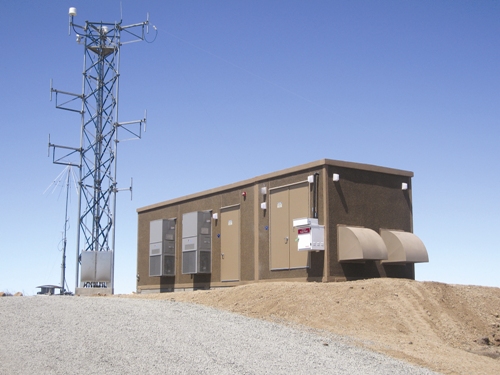
Telecommunications and Remote Shelters
Equipment shelters in classified areas — telecom huts near refineries, remote wellhead shelters, pipeline monitoring stations — need reliable cooling to protect electronics from heat damage. These are often small enclosures with modest cooling loads but strict classification requirements.
Typical unit: Window or small wall-mount, 0.5–2 tons
Common Questions and Misconceptions
”Explosion-proof means it can survive an explosion, right?”
No. This is the most common misconception. Explosion-proof means the equipment cannot cause an explosion. It has nothing to do with surviving blast overpressure. If you need a structure that survives an explosion, you need a blast-resistant module (BRM) — and you may also need explosion-proof equipment inside it if the BRM is in a classified area.
”Can I just put a regular AC in an explosion-proof box?”
No. The motors inside a standard air conditioner are ignition sources. Putting the whole unit in a sealed box does not address the internal ignition risk — the flammable atmosphere is already inside the sealed space with the equipment. Each individual component that could be an ignition source must be independently addressed.
”Is Division 2 really less dangerous than Division 1? Can I use cheaper equipment?”
Division 2 means the hazard is present only under abnormal conditions — but abnormal conditions happen. Equipment failures, maintenance activities, process upsets, and valve leaks are all real events. Division 2 equipment is less extensively modified than Division 1, which does make it less expensive, but it is not “non-hazardous” equipment. It must still be specifically rated for the classification.
”What’s the lead time?”
Typically 4–8 weeks from order to delivery, depending on the base unit availability and the complexity of the modification. Rush orders can sometimes be accommodated. Quotes come back in 24–48 hours.
”Can you modify any brand of air conditioner?”
Yes. While Bard wall-mount units are our most commonly modified base unit, we can apply explosion-proof modification to virtually any brand — Trane, Carrier, Lennox, Mitsubishi, or others — when a specific unit is required for the application.
”What about maintenance?”
Explosion-proof air conditioners require the same routine maintenance as standard units — filter changes, coil cleaning, refrigerant checks — plus periodic inspection of explosion-proof seals, conduit fittings, and enclosure integrity. Maintenance must be performed by personnel who understand hazardous location requirements. Opening an explosion-proof enclosure in a live classified area requires specific procedures (hot work permits or de-energization).
”Is ATEX the same as explosion-proof?”
Not exactly. ATEX is the European certification system for equipment used in explosive atmospheres. US explosion-proof equipment is certified under NEC/UL standards. The two systems have different testing procedures, markings, and documentation. Equipment certified under one system is not automatically accepted under the other without engineering review. See our NEC 500 vs. 505 comparison for more on how the classification systems relate.
”Do I need explosion-proof AC if my building is pressurized?”
Maybe not — and this is where significant cost savings can happen. If your building can be sealed and positively pressurized with clean air per NFPA 496, you may be able to use standard HVAC equipment inside while only explosion-proofing the outdoor condenser and the pressurization system itself. This can reduce total project cost by 60–80%.
Getting Started: How to Get a Quote
Getting a quote for explosion-proof air conditioning is straightforward once you have a few key pieces of information. Here’s what we need from you:
The Quote Checklist
Required:
- Classification — Class, Division, and Group (e.g., Class 1, Division 2, Groups C & D)
- Cooling capacity — BTU or tonnage requirement (or space dimensions + equipment list so we can help you estimate)
- Inside only or full inside + outside — Is the condenser in a classified area?
Helpful but not required for initial quoting: 4. Unit preference (wall-mount, split, window) — or let us recommend based on your application 5. Site conditions — corrosive atmosphere, extreme temperatures, altitude, special materials 6. Documentation requirements — standard or full certification package 7. Project timeline — standard or expedited delivery needed
How to Reach Us
Phone (fastest): Call (844) 925-5668. Most initial conversations take 10–15 minutes, and we can often give you a ballpark number on the first call. Firm written quotes follow within 24–48 hours.
Quote form: Request a Quote online and we’ll call you back.
Email: Reach us through the quote form with your classification and requirements and we’ll respond within one business day.
Why Work With Us
We are one of the last independent explosion-proof air conditioning specialists in the United States. One large consolidator has acquired most of the modifiers in this space. We remain independent — which means faster decisions, direct access to the people doing the engineering, and no corporate layers between you and your quote.
Our equipment is installed at virtually every major oil refinery in the country. We have supplied explosion-proof HVAC to ExxonMobil, ConocoPhillips, Halliburton, Northrop Grumman, Pfizer, and dozens of other industrial, military, and government facilities.
We specialize in this and only this. Explosion-proof HVAC is not a sideline — it is our entire business.
Related Pages
- How Much Does It Cost? — detailed pricing breakdown
- How to Choose an Explosion Proof Air Conditioner — step-by-step buyer’s guide
- Explosion Proof Bard Air Conditioners — the most common unit we modify
- Explosion Proof Mini Splits — the most affordable option available today
- Explosion Proof Window Air Conditioners — currently unavailable due to refrigerant standards
- Explosion Proof Split Systems — for higher capacity or no-wall-penetration installs
- Pressurization Systems — an alternative that can save 60–80%
- Class 1, Division 2 Explained — the most common classification
- Class 1, Division 1 Explained — continuously hazardous areas
- Class 2, Division 1 Explained — combustible dust environments
- NEC Article 500 vs. 505 — Class/Division vs. Zone classification
- Oil & Gas Applications
- Chemical Plant Applications
- Mining Applications
- Pharmaceutical Applications
- Military & Government Applications
- FAQ — quick answers to common questions